marketing manifesto
The evil, vile world of marketing & sales.
Phase I: Amazing Work
Let’s stipulate that you have made something amazing. In some ways, now you have an even harder job ahead of you—because now you have to make people care. Art is a kind of a marathon where, when you cross the finish line, instead of getting a medal placed around your neck, the volunteers roughly grab you by the shoulders and walk you over to the starting line of another marathon: marketing. The quality marketers are the ones who think relentlessly long-term, put out quality content, and recognize the value in building deeper, real-life relationships with their peers.
The vast majority of creative work, sadly, is not only forgotten, it never had a chance to be anything but forgettable. Since it launched in 1985, some 6,000 films have appeared at Sundance with 17,000 being submitted in 2024 alone. How many of these products endured for years or decades? Not many. The key missing ingredient is marketing. Like a knife, media & marketing can be used for saving lives (i.e. surgery), taking them, and lots in between. How the knowledge is used is up to the user. Getting people to care about what you’ve done is an exhausting and bitter fight for the world’s most precious resource: time. To capture it, you must be a skilled and fluid marketer who can create or spot opportunities to leverage. In the words of Elon Musk, “it is constant work to get people to care”.
The aim here for us is to make a classic, not a commodity - the kind of films, content, and products that customers return to more than once, and recommend to others, even if they’re no longer trendy or brand new. We make things that last—not for months but for years. As Paul Graham said “The best way to increase a growth rate is to make the product so good people recommend it to their friends.”
That means we must think relentlessly long term and not chase after trends. The point I’m trying to hammer home here is that the first and most essential step of marketing is creating something truly great. As Robert Greene put it, “It starts by wanting to create a classic.” If you’re sitting down to make something and thinking about how famous it’s going to make you, how rich you’re going to get, how fun it’s going to be, or all the people you’re going to prove wrong, you are thinking about the wrong thing. Movies take forever to make so you can’t hope for a quick buck. Imagine this scene being translated into Thai and being watched in 2040 to gain a better perspective.
Rick Rubin, famed music producer urges his bands not to listen to the radio while producing an album “I urge them not to constrain themselves simply to their medium for inspiration—you might be better off drawing inspiration from the world’s greatest museums than, say, finding it in the current movies at the theater” he says “I don’t want to water down. The idea of watering things down for a mainstream audience, I don’t think it applies. People want things that are really passionate. Often the best version is not for everybody. The best art divides the audience. If you put out a record and half the people who hear it absolutely love it and half the people who hear it absolutely hate it, you’ve done well. Because it is pushing that boundary.” In the short term, this choice almost certainly cost them some radio play. But when Rubin says that the best art divides the audience, he means that it divides the audience between people who don’t like it and people who really like it.
Another example is The Star Wars franchise. In one sense, the films were undoubtedly futuristic and took advantage of cutting-edge special effects. But George Lucas borrowed far and wide. He acknowledged that his initial conception of the movie was for a modern take on the Flash Gordon franchise, going as far as trying to buy the rights in order to do so. He also borrowed heavily from the 1958 Japanese movie The Hidden Fortress for the bickering relationship between R2‑D2 and C‑3PO. Yet for all these contemporary influences, Lucas’s most profound source material was the work of a then relatively obscure mythologist named Joseph Campbell and his concept of a “hero’s journey.” Despite the special effects, the story of Luke Skywalker is rooted in the same epic principles of Gilgamesh, of Homer, even the story of Jesus Christ. Lucas has referred to Campbell as “my Yoda” for the way he helped him tell “an old myth in a new way.” When you think about it, it’s those epic themes of humanity that are left when the newness of the special effects fall away. Jon Favreau, who created Swingers, Elf, and directed Iron Man has said similarly that he aims to touch upon timeless problems and myths for specific groups of people in his work, and that all great filmmakers do as well. “The ones who get the closest to it,” he said, “last the longest.”
In terms of marketing films, there will be no silver bullet - we’ll have to use a whole lot of normal bullets. You may feel like the wretched employee of your former self. The former you, being the happily engaged creative artist who now sends the current you, a kind of door-to-door salesman, out on the road to hawk his work. He had all the fun making it. Now you're the poor bastard who has to go sell it. But keep in mind, no one is going to sell it for you & if you aren’t willing to sell it yourself - being the person who made it - why the hell would anyone be willing to buy it?
This leads me to the story of Richard Bachman. Do you know who Richard Bachman is? He was a struggling writer in the 80’s. By all accounts he was a failure, not even selling out the prints (already made copies) of his books. His turn around came with the book Running Man, which was later made into a feature film starring Arnold Schwarzenegger, that was produced 5-years after it was published. How did this failure of a writer turn it all around? Why did the book sit idle for 5-years before being picked up to feature in a Hollywood movie? Because 5-years later Richard Bachman was outed as the alias for the writer Stephen King. Once word got out all “Richard Bachman” book sales rose by at least 10x. Keep this in mind, you can write great stuff but if no one knows who the fuck you are it won’t matter - even if you’re writing is as good as Stephen King. The message is obvious enough: readers won’t think twice about buying books from authors they know and recognize.
Marketing is what separates the successful filmmakers from the amateurs who hug the bottom of the ladder. Streaming essentially inverts the traditional film model, where producers who publish a movie, then get the media to drum up enthusiasm before the public can pass it along through word-of-mouth. Self-releasing filmmakers must do this entire process in reverse: they must get people interested in their films before they actually debut the film. It requires building relationships with your viewers and establishing a sense of community by leveraging social media. Making a successful film is like losing 100lbs. It’s doable and can be replicated with a recipe of success but it will be hard - but doable nonetheless - and below is that recipe.
TLDR: Everything starts with great work: Make a classic.
Phase II: Set Up Shop
You’ll want to embed yourself into the internet. This means setting up on social media platforms (FB, X, IG, Pinterest, Youtube, Linkedin) as you just simply don’t know which one is going to take off and most of them are iterations of the same two things: Pictures & Articles. This is good as it allows you to cross post the same thing on multiple platforms and let the hands of fate decide which one is best suited for your voice. You don’t need to be on all social media platforms. People like Tucker Max never had a Linkedin or Youtube and sold millions of books & made feature films. Unless you can use the medium effectively - don’t use it.
If you’re going to be blogging on your own website then it’s pretty easy to place those same posts on LinkedIn - and it’s even easier to put the catchy header on X with a link to your website where you can funnel them into an email list. Same for Instagram. If you’re already taking pictures, you might as well use Snapchat to see which pictures are getting the best feedback (views/screenshots) and then post the best ones on IG. If you’re already posting them on IG may as well cross post it on Pintrest. A linktree sits in the bio of each platform directing them to your website where you can accrue sales - but I’m getting ahead of myself.
Stepping back for a moment, let's delve into the essence of cross-platform promotions: Similarity. It’s paramount to ensure our profile picture and description remain uniform across all platforms. We also must equip our tribe with a badge—a symbol that embodies our brand, much like Apple's logo or Bam Margera’s heartagram.
Heed the sage advice of best-selling author Barry Eisler: "Don't use social media to sell; instead, offer valuable insights and engaging content for free, fostering genuine connections. Your aim on Facebook, Twitter, and beyond should be to enrich the lives of your friends and followers. As they find value in what you share, they'll naturally gravitate towards you and develop an interest in your work."
For burgeoning filmmakers, maintaining a unified presence across diverse social media platforms is key. You're essentially sculpting your personal brand. Choose a striking profile image and ensure its consistent use across all websites, including your blog and social media channels. This harmonious visual identity not only bolsters your brand's recognition but also cultivates credibility and resonance with your audience. Use a professional headshot and if you’re not literate in Canva, use Fiver or 99Designs to create your cover photo & logo.
Website:
It’s important to have an authority page to transfer people who are interested in your work too. The key thing is to give WAY more than you take. Rarely, if ever, ask for anything. Just focus on putting out quality content our readers & viewers will like. That means telling or sharing lessons worth learning and doing it in a compelling & consistent voice. If we are to make a big ask, attach a reward to it so the audience will take action. For instance, “Help me promote my movie” becomes “If you help me promote my movie, you can win a free round-trip ticket to anywhere in the world.”. Always appeal to self-interest.
Some structural notes for the site:
Have a most popular section and a favorites section on sidebar
7a.m pst & 6am est for Tues, Thurs, and Sat high traffic times. So post important shit friday night
1-2 posts per week
Don’t name it categories, name section topics
Don’t underestimate copy and labeling: 7-reason, 9 steps to, top 10, Top 3, Top 5.
Gear, resources, and forums have good click through rates
New visitors have bias for new info so hide publishing dates.
Put total read time at top. Bold sections in the article for TLDR ending.
If writing a negative article, write about problem not person
Share advice and tips related to your niche.
Alliteration in titles
The key, if doing a questionnaire, is to keep it brief (six questions max) or simple (check-boxes).
Register the URLs for your name
89% of journalists reported using blogs for their research for stories. Great way to gain influence & connections.
The website also allows you to create a very valuable x-factor when it comes to marketing: Email Lists.
Email lists are used to great success in what is called “permission marketing” made famous by Seth Godin. For example, you can accrue emails by offering a once weekly newsletter in our niche (Box office breakdown) which includes top-3 movies at box office that week, top-10 streamed movies that week, and top-10 streamed shows that week. We include any weather or cultural events that may have affected the box office & include a monthly breakdown as well (The Month in Movies). We also offer a movie recommendation based on the week or a monthly theme and if needed we can list updates on the production schedule of our upcoming projects. The footer includes links to our other sites (LinkedIn, X, Tk, IG, FB, Blog).
This is also a strategy used in Direct-Marketing quite cheekily. Instead of marketing your services, you market your free stuff (like newsletters) which creates a more targeted sales funnel for you to attack. For example, the mattress store doesn’t advertise itself, its mattresses, or some sale of the century - it advertises its free guidebook. The karate school doesn’t advertise itself, its lessons, or even a time consuming free lesson - it advertises a free report by its owners: “The parent's guide to cyber bullying & bullying.” which targets the actual decision makers - parents. Alway include, if offering free reports like our Month in Movies, that it will be sent by email, no cost, no obligations and that they can opt out anytime.
When Ryan Holiday was writing his book The Daily Stoic, he built a 40,000 person email list by sending out one free meditation every single morning. This is an incredible amount of work. Basically, one additional book written per year, and he did it totally for free. BUT - it helped the book spend 5 weeks on the Wall Street Journal list without really any other marketing. The book now sells 1,000-1,200 copies per week. Before social media, Kevin Hart would put questionnaires on every seat before the show saying “Kevin Hart needs to know you” and have them write down their email. He’d get one of his guys to collect the cards at the end of the night and then send emails thanking them for coming to the show. This was important for Hart, as the next time he was going to be in town, he’d just send out emails to old guests & his shows would sell out. He got this system from Dane Cook who used the formula to not only sell out his shows, but put two of his stand-up specials on the top-10 highest selling comedy albums of all time. Simply put - It’s easier to preach to the converted - andthe same goes for sales. Selling to an existing client is 60% more probable than a new client. Retention trumps acquisition. Movie studios do this as well during private screenings to make the audience feel as if they were part of the ‘making of’ the movie, which turns them into zealous preachers of/for the film. Politicians the same, as it creates an invaluable foundation to be used on future campaigns (read: future movie launches).
Permission marketing recognizes the new power of the consumers to ignore marketing. Permission is like dating. You don’t start by asking for the sale at first impression. You earn the right, over time, bit by bit. Subscriptions are an overt act of permission. That’s why home delivery newspaper readers are so valuable, and why magazine subscribers are worth more than newsstand ones. Create a google sheet to keep track of the email lists.
Make sure to be consistent in your posts by planning our weekly articles 3-months to 1-year in advance. A neglected site looks like a barren ghost town so keep it up. You can even sell your blog if you so choose. The blog also offers a great testing ground for another strategy - ebooks. Ebooks are relatively easy to ‘game’ to appear at the top of the amazon best seller charts for extremely narrow niches. Use the blog to test book ideas (i.e Cowboy Filmmaking) that can be used in the future as a credibility indicator. We can even use our fans to crowd edit the book, which will turn those fans into the most proud supporters of it as they had some part in the ‘making of’ the book. This also operates as a great dry run for a movie launch as we test book titles, copy, and cover art. The ebook will be offered at $2.99 on Amazon since it costs us nothing to distribute. The lower price encourages discovery which is what we are truly after. This also will help in rankings as we target weekly sales which is what determines the list itself. Publishing a book is not just putting your thoughts on a blog post. It’s an event. It shows your best curated thoughts and it shows customers, clients, investors, friends and lovers what the most important things on your mind are right now.
Stealing the process from James Altucher, one of the top self-publishing authors alive, who recommends the following:
Hire two copy editors to go through basics of spelling & grammar
Hire command z editing for structural edits
Hire design firm
Hire marketing firm
BrassCheck: Ryan Holiday
Hire audio firm
8hrs per day of reading the book. Utilize AFS Podcasting suite.
Test title
Pick 10 titles that you like & combine them with the created cover. Use FB ads, send to friends, and watch for click-through rates. After a few days, or thousands of click throughs, determine top-3 titles.
Same process for subtitle & design cover
Sell foreign rights
Foreign rights agency: 2 Seas Agency (Commission basis)
Shopify:
Merchandising is a huge revenue stream so it would make sense to have a distribution setup on your site. This can be done by utilizing shopify and integrating Alibaba for gear. This will also help come swag bomb time (more later) and to disseminate our brand/symbol to our people. Merchandise should not be generic, but a representation of our creativity. If you put it on a T-shirt, would people wear it? There is no use being remarkable at something that people don’t care about. Not ALL people, mind you, just a few. A few people insanely focused on what you do is far far better than thousands of people who might be mildly interested. Some gear ideas are below:
Trucker Hat
Tesla Jacket, T-Shirts, Shirts, Windbreakers
Puffy Socks
Puffy Jacket
Supplements (T-Kino, Collagen, Preworkout, Vitamin-D, Sleep support, Immune System)
Programs (Remote work, Fitness, Filmmaking)
Jerseys
Beer glass, Water bottle, Coffee mug
Fanny Pack, Backpack, & Rucksack
Lanyard, Key Chain
Blue Light/Sunglasses
Blankets
Conditioner for hair
Bracelet & Wrist Sweatband
Athletic Shorts
Blender
Stickers
Nasal Strips & Teeth Whitener
Foam Roller & Yoga Mat
Pull-up Bar
Headband & Bandana
Jump Rope & Bands
Yoga Pants & Sports Bra
Leopard Underwear
Posters
DVD’s
Acne Prevention
X: (Company & Personal)
Personal Model: Ryan Reynolds, Kevin Hart, Dwayne Johnson, and Elon Musk. Do funny tweets & vague comments, Congregate a list of 100 tweets that grab your attention and study them. Make tweets shareable as well. For example, don’t say “Why I hate -” , say “Why Dick Richards hates” - makes it more shareable.
The art of X is the headline, which will be the same as one on blog & LinkedIn. For example, if you’re into trapeze or German techno, the starting headlines might be “How to Perform 5 Tricks on the Flying Trapeze” or “German Techno 101.” That’s just a starting point. Then we expand to what your wider circle of friends or co-workers might be interested in. For example:“How German Techno Can Make You a Better Agile Programmer” “5 Principles of Flying Trapeze for Better Hiring Decisions”. The “science” is borrowing headlines or testing them. Determining pass-along-value by the numbers.
People retweet without reading where the link leads all the time. Plan accordingly. How do you learn what works? Headlines are as old as writing itself. There are many sources, but rankings and data sets (often prolific bloggers) are what you want. Never tell the whole story in the headline if you want optimal click-through. “Home Prices Drop 47%, Largest Single-Quarter Drop in 50 Years” isn’t nearly as good as “Largest Drop in Home Prices Since 1960: The Reasons, Numbers, and What You Can Do.”
There’s another element in the latter that makes it superior: it’s prescriptive instead of merely descriptive. People don’t want more information about their problems; they want solutions to their problems. Piquing curiosity can be done with questions instead of statements, and question-based post titles are some of the best performing (such as “Why Are You Single? Perhaps It’s The Choice Effect“), unless used more than 20% of the time, at which point, it appears that readers suffer “question burnout” and click-through plummets. This is a common problem with (over)use of lists (“17 Things You Can Do For…” etc.). Would “Why Are You Single?” have worked well by itself? I don’t think so. But what the hell is “The Choice Effect”? Once again, this is exactly the point. I want that question to bother you enough that you click on the link and, most important, read the piece.
So for twitter posts, 1/5 are questions, 1/5 lists, so on. So that’s 40%. Another 20% is the red zone. WTF is the Red zone? Pretty much a title with an unknown label in it. Lastly, timing. If you were to post in one 1.5 hour window during the day, the most effective time frame would be 1:30-3pm PST (4:30-6pm ET), which averaged 6 top-30 hits per hour. It’s possible the 4-8am PST period could beat this. 70% of the most-clicked Tweets are statements, but 4 of the 4 questions in the top 10 were opening questions. If you include a question, using it to begin the Tweet will increase click-through.
The headline is everything. This refers to the blog & LinkedIn just as much as the X post. Ultimately, the headline is what will draw them in or have them re-tweet. The greatest ad man of the 60’s-80’s was a man called David Ogilvy, who stated that “Write a great headline and you’ll have successfully invested 80 percent of your money”. Now think how much more headline driven today’s society is. Big, bold, and stark was his maxim and he believed the key to good advertising was in your offer to customers.
Don’t post about what you had for breakfast or your favorite color. Pretty much every tweet is either informative or funny–i.e., they are entertaining, which is the added value fans expect. Same with Facebook; it’s information about things your fans care about, or bantering with people. You can’t outsource something funny so don’t have an assistant do that part.
LinkedIn: (Company & Personal)
Post our articles here as well. This is more of a dump site for our stories & email newsletters. LinkedIn is a professional site so keep it on brand. Shirtless pictures may work great on Instagram but will get you booed off stage of LinkedIn (unless you put some dumb sappy story about your dog dying during a layoff or some shit.) This is a business networking site so use it as such. This is also to be a dump site for our video interviews (TikTok/Youtube) as well.
SNAPCHAT: (Company)
Data testing dump page for Instagram & TikTok. Posts that get most views & screenshots are aggregated down into a top ten list including time of posting. That list will determine the weekly IG picture & comment.
IG: (Personal)
3x/week stories & 1x/week post. Linktree in bio to cross reference. This can be used to grow your reputation by association as you gather pictures with industry professionals (credibility by association).
TikTok: (Company)
Post clips of films & interviews.
Youtube: (Company)
Start by posting five 20-minute videos on your page to establish ‘thesis’ of channel.
Non-Obvious:
Quora: Answer questions related to your niche
Reddit: AMA’s on appropriate sub-reddits & comment
Comments: “Blog posts” in comment sections of on-brand competitors.
Guest Post: Guest posts on niche specific blogs
Use hashtags. Getting new Twitter/Instagram followers is all about getting in front of new people. There are a few ways to do that, but the simplest is hashtagging; anyone who is searching through hashtags is actively looking to follow and interact with new people.
Now it’s important to note that social media is a symptom, not a tactic. If you spend all your time beginning at the end, grooming your social network, tweezing your Insta posts, hyping your tweets–nothing much is going to happen. The Mona Lisa has a huge social media presence but she doesn’t tweet. She’s big on social media because the artwork is iconic, but she’s not an icon because she’s big on social media. The narrative of social media grooming is a seductive one, but it’s as much of a boost to your work as spending an extra hour picking out which tie to wear before a speech.
TLDR:
Set up shop (FB, Youtube, IG, LinkedIn, X)
Use same profile pics & description
Entertaining or informative posts.
Phase III: Output
The first principle of output is obvious: Make consistent content in your niche. This is explained in depth in section I & IV of Phase 5 (i.e unguarded niche).The next principle? Invest strategically. Allocate your funds (we're talking $50 to $200 here) exclusively to what delivers results. Platforms like Instagram offer boosts for your posts, but hold off until you've struck gold. Let the market's preferences guide your content strategy. Only ‘boost’ posts that are prior hits with your audience. Ian Fleming, the commercially minded creator of the James Bond franchise, advised his publisher not to advertise for his books until after they’d begun to sell well, not only offering to share the costs (£60 for every £140 the publisher put in), but even submitting his own ad copy.
Next step - Collaborate. Dive into the deep end with others in your niche. Your mission? Convert their followers into your tribe. How? It's all about them. Craft your collaboration with their audience in mind. Make it irresistibly valuable so they can't help but hit 'share'. Think guest posts, freelancing gigs, speaking engagements - anything to broaden your reach. If you’re doing guest spots, always do the first session for free. The trick is getting someone who will take videos & photos every once in a while during your performance/lecture/whatever for content that can be leveraged for further opportunities via your social media channels. This is often referred to as fusion marketing. Fusion marketing is when you're watching an ad for McDonalds before realizing it’s a commercial for a Disney movie and then seeing it was actually an ad for coca-cola all along.
Tying into this principle is that you must make your content easily shareable as stated in the blogging section. The beauty of digital media is that additional copies (after the first) have a zero transaction cost and most posts cost nothing to begin with. This means people who like your content can easily share it with lots of other people, promoting your content for you, especially when you make the sharing process effortless for them. An example of this is clips from movies, podcasts, sketches which are easily shareable. DON'T be afraid to give stuff away for free to build a following (i.e your short films). As MIT’s Henry Jenkins puts it: on the web, “if it doesn’t spread, it’s dead”.
How can you ensure shareability? Valence (happy or angry) is the key metric. Nothing sad! Scandal, conflict, titillation, dogmatism - whatever will ensure transmission. Huge part of sharing is what someone is just passionate about and wants to shine a light on. Polarizing people - those who threaten the 3 B’s of behavior, beliefs, and belonging - are often on the top of charts, but so are the really nice people (Keanu Reeves & Steve Irwin). This is also important for media coverage - give them what spreads. Hopeless despair doesn’t spread, empathy & pity will get them to feel, but anger, fear, excitement, outrage get them to act. Be consuming without frustrating, manipulative without revealing the strings.
Harkening back to the original and core theme is to simply make good shit. Everything, and I mean EVERYTHING, flows from that central principle. Most online marketers have a short attention span, a weak filter, and an inability to communicate face-to-face. They salivate when they hear the word “viral” and send out 40 links a day on Facebook or post the same dumb Instagram post daily. They unknowingly sabotage their own credibility and ensure people won’t pay attention to them when they need it most. YOU MUST control the sprout of information & make sure it is of quality work pertaining to your niche.
This leads us to CONSISTENCY. Consistency is key. Take the world of podcasting - 70% of podcasts don’t have more than 10 episodes! Stamina is paramount. You can do this by scheduling out your distribution based on different social media channels. This is discussed in the setting up shop section. You’ll want to respond to every DM & Comment in the beginning. This is part of the strategy that comedians like Dane Cook & Kevin Hart used to grow their following. Dane Cook would go as far as calling fans who doubted the authenticity of his messages.
Consistency is key as output repetition is crucial for brand recognition. The 20th time they see an ad is when they’ll finally buy. Consistency breeds familiarity, familiarity breeds confidence, and confidence breeds sales. All marketing strengthens identity. If you halt the campaign you shortchange your reputation & reliability. Your customers lose confidence in you. You must keep up marketing efforts as it enables you to keep customers, maintain morale, and have an advantage over those who do halt. If you halt you lose everything. Halting saves money the same way stopping your watch saves time. Changing the campaign dilutes the marketing. Don’t change it or halt it, let it get boring - that’s when it starts to work.
Just like in marriage, it takes commitment to make marketing work. You won’t know the success of your campaign for at least 60-days before the avenues start to link with each other. Marketing is an assortment of weapons, often at least 20. Different wars require different tactics. Email by itself doesn’t work, social media by itself doesn’t work, a e-store by itself doesn’t work: but together they do.
Frequency is more important than reach. In order to follow a consistent output a media plan reaching out for 3-months to one-year should be planned. The plan should include exact details such as: cost (typically projected as a % of gross revenues between 7-15%. Marketing budget is divided into thirds: development, promotion, maintenance), names of newspapers, blogs, tv shows, dates, size of ad, frequency of ad, and PR contacts. When creating a media plan don’t include support info with the document (such as this one) or information more relevant to the business plan like research, competitive situation, and financial projections. These should not be in the marketing plan.
Don’t give the stamp of approval until you're ready to commit at least 3-months to it with realistic expectations for returns. Test the campaign before committing to it to see what gets the best responses. It’s not enough to have a good idea, you need to have a serious focused strategy as well. Serious in the beginning could mean $100/mth. Keep track of marketing efforts through the calendar to eliminate those that miss mark and add to those that hit bullseye. Remember - marketing is a process, not an event.
People love finding new things that interest them, so go out and find audiences who might like your stuff and the places where they congregate. Then interact with them not as a huckster, but in a way that potentially benefits you both: You find the audience, they find new entertainment (or information, or whatever value you're providing). Watch Tai Lopez in his house on the phone in a normal outfit to see how just being normal is enough to get people to sit through an hour long ad. If you talked to people the way advertising talks to most people they’d punch you in the face, so as hokey as it sounds - just be you.
The general secret is that you need to find the fulcrum of attention for your specific niche, and then use it to leverage yourself attention so that you can turn it into new viewers. If you’re unsure how to do this, ask yourself, “What is interesting or engaging about my writing/posts/pictures/content to other people? What about my writing/posts/pictures/content are people responding to? How can I use that to get more attention?” Marketing is like a shovel, you can’t dig a hole unless you pick it up and use it consistently.
TLDR:
Make Niche Content Consistently
Invest Strategically
Collaborate
Make Content Shareable
PHASE IV: MEDIA COVERAGE

Sadly, most filmmakers aren’t prepared for national media and do more harm than good with a premature (and non-strategic) jump into the spotlight. The New York Times or Joe Rogan doesn’t often do two major stories or interviews on a single person or company, so that first — and possibly only — appearance is what counts. So be ready. Prepare main talking points and sound bites for your media coverage. The good thing for you is that media coverage isn’t magic, and it need not depend on luck. It can be a step-by-step process:
Create a reel.
Appeal to self interest of local influencers & collect footage. Never forget, these folks aren't in the business of doing you favors.
Look for a local affiliate of big networks like ABC, CBS, or NBC - and find something controversial and timely to discuss.
Read the news & formulate a simple, provocative, and valid position on a topic you are an expert in. It doesn’t take much to be an expert as it is an ill defined term that usually only merits prior experience for acceptance. If you find a story or want to hop on one, the week before, reach out to all local big networks. Call the switchboard or main number, request “the newsroom,” and start the pitch, which is to be written out on paper in front of you and never lasts more than 20 seconds: “My name is ____ and I have a timely pitch for you. I work with _____ (Credibility)… [establish credibility by your role]”, “____ about ______ comes out next week and it’s getting a lot of attention. Most of the world is viewing it as an exposé that will ______. They’re wrong. I can discuss why it will actually ________” Most calls will go to voicemail, a few people will get back to you, and only one will have you on - but one is all it takes.
As a vital component of your strategy, it's imperative to shape the conversations surrounding your brand. Don't wait for the news—create it. As the saying goes, if we play by their rules long enough it becomes our game. Craft compelling narratives tied to a "Peg". Apologies for the jargon, but understanding the mindset of journalists is key. Major trends and hot topics serve as "pegs" to anchor your pitches. Whether it's a high-profile event like the Olympics or a more nuanced trend, seize the opportunity to align your brand narrative. Take, for instance, the billion-dollar acquisition of Instagram by Facebook. Michael Seibel, CEO of SocialCam, deftly capitalized on the media frenzy surrounding the acquisition, positioning his mobile video-sharing app as the next big thing. Predictably, discussions swirled about who would emerge as the "Instagram for video," with SocialCam prominently featured in every discourse. Completely off topic, but this sale is also what caused the Chinese government to fund and create TikTok for data collection and mass media manipulation.
Take advantage of the cycle — Almost every day Google gets press for its Google Doodles—because they celebrate a theme, or a historical event, a famous person’s birthday, etc. If there is a big story about cybersecurity in the news and that’s what your product does, jump into the fray. There are a finite number of spots in the paper. Blogs are different, as they can publish an infinite number of articles and every article they publish is a chance for more traffic (which means more money in their pockets). In other words, when Business Insider writes about you, you are doing them the favor. Getting press on those outlets is no longer a buyer’s market. It’s a seller’s market. And there are a lot of blogs out there willing to buy your story. That means your product, your movie, or your start-up has more than a fighting chance of getting press.
You want press tomorrow? Sign up for HelpAReporterOut.com (note: company sold April 24’). You won’t be the sole subject of a story, but you’ll be in a story and that’s a start. Legitimate coverage can also be secured by going even smaller. Small blogs & hyperlocal websites that cover your neighborhood or particular scene are some of the easiest sites to get traction on. Started a company? Snag an article in the newspaper where you went to college. Making a movie? Get the blog that covers your neighborhood to do a post on you. Since they typically write about local, personal issues pertaining to a contained readership, trust is very high. At the same time, they are cash strapped and traffic-hungry, always on the lookout for a “big story” that might bring a big spike of new viewers. Starting small is your beachhead into the news cycle. Blogs have enormous influence over other blogs—making it possible to turn a post on a small site into posts on large-traffic sites, as the bigger often “scout” the smaller sites. Blogs compete to get to stories first, newspapers compete to “popularize” it, and then everyone else competes to talk about it. This section is crucial in getting the social proof needed for the next step.
Leverage up/Feed the Monster:
Remember: make it timely and controversial. “Controversial” doesn’t necessarily mean scandalous; it means a position that runs counter to the mainstream or expectations. The same can be done for radio, which is a far easier sandbox to play in, as there are more players. Invite the hosts on set and encourage some sort of silly exploit. Doesn’t even have to be in regards to your niche. Producers of radio — just as in TV — simply want to know you’ll speak clearly, be entertaining, and not embarrass them. The subject matter doesn’t matter. On a higher level, they want to know: can you help design a fun segment? You can later use this to help batch “Radio satellite tours” which entail sitting in a room with obscene quantities of coffee and doing back-to-back 10-30-minute radio interviews from 7am to 5pm with almost no space for even bathroom breaks. Feed the Monster: You must constantly feed the internet. New York Times Magazine found that the secret to popularity was how much emotion an article generated in the reader. In fact, the number one predictor in virality was how angry an article made the viewer. There are, in fact, many viral emotions: humor, anger, fear, joy, awe, primal attraction, etc.. The one thing they all have in common: passion/extremeness. These are called “high-valence” emotions. The internet is a hungry beast that needs material: FB and Twitter don’t feed themselves. Armed with data that shows a direct correlation between chatter about products and sales spikes, Ryan Holiday used emotion-provoking advertising to grow American Apparel’s online sales from $40 million to $60 million per year
Trade up the chain: Start small — In 2015, Ryan Holiday appeared on a small podcast to discuss The Obstacle is the Way’s impact in professional sports. That led to this piece on PatriotsGab.com which led to a Sports Illustrated cover story. The most important thing to remember if you have a budget for your work: Advertising can add fuel to a fire, but rarely is it sufficient to start one. F. Scott Fitzgerald’s editor Maxwell Perkins once wrote to one of his authors comparing advertising a product to a man attempting to move a car, “If he can get it to move, the more he pushes the faster it will move and the more easily. But if he cannot get it to move, he can push till he drops dead and it will stand still.”
Now that you have a story. Blow it up. Make SURE it is on everyone’s radar. Submit it to social media sites, submit it as a tip to other news sites, drive tons of traffic to it. Email other blogs and offer to do an interview and get follow-up stories. Once you start, you can’t stop. Tomorrow, come up with a new story and start again.
Know Your Subject: In Depth vs. Talking Points
Whittle down your pitch to 3-6 major points you can convey in a total of 120 seconds, 20 seconds or so per point on your story. Answer a few things on a small sheet:
“Why is what I’m doing different or controversial?”
“Why is this timely and important?”
“What are some actionable examples of counter-intuitive findings?”
For the last group of actionable takeaways, list them first, then number them in descending order of priority for inclusion. They’re the same talking points you’ll use in radio satellite clips. NEVER assume you’ll get to cover everything you hope or rehearse. Media is unpredictable.
Why this order? Because it makes no sense to pitch until you have your prep (reel or sample clips) and basic positioning (timely and controversial angle with examples) in place. Then, before you start spamming people with template emails, keep in mind: Thou shalt know thy media outlets. Don’t pitch the same thing — or something general — to niche outlets. It’s a waste of their time and yours. Know the magazine or program and customize.
One size does not fit all — If you’re sending press releases or standardized pitches, you’ve already lost. You’re just contributing to the noise. Really study the work of the people you want to write about you. Don’t pitch people who don’t cover what you do. Build a relationship (before you ask for anything). Be a human being. Focus on what’s unique and special. Whatever is most special about you, lean into it with your pitch. It's not always about pitching; prioritize cultivating long-term connections, as they yield enduring dividends. Always try in person. Here is a sample email for your pitch to someone you have a prior correspondence with:
Hi [Name],
OK, here are a few ideas. They’re in three categories:
1) Feature
2) Shorter 1-2 page piece
3) Book mention in Playlist
My preference if possible, no big surprise, would be 1, 2, and then 3. Here are the toplines:
1) Feature:
For Wired readers, being one myself and having been in the mag before, I think one of my chapters as an exclusive excerpt would be the least work for Wired and the best fit. It’s ready to go and would just need to be tightened for space. I’ve attached the latest version (sorry for the hand edits). Here are some headlines and toplines:
BLOOD HACKING: Creating the Perfect Fat-Loss Protoplasm
I implanted a medical device in my side that sampled interstitial glucose levels every 5 seconds. It’s used by cutting-edge Type 1 diabetics, but I used it to figure out which foods and meals would make me fat. I wore it 24/7 for weeks, including a trip through customs to Nicaragua. There some sweet graphics and nice how-to takeaways I can provide.
Other potential headlines:
Tracking Blood to Lose Bodyfat
BLOOD: Self-Experimentation for Losing Bodyfat (could appear on the cover like this: http://www.flickr.com/photos/timferriss/5388565667/ [NOTE: In the actual e-mail I used a private Skitch link]
Diary of a Blood Tracker
2) Shorter 1-2 page piece
This would detail 5 or so of the coolest and craziest drugs and tools I used in my experiments over the last 3 years, ranging from the above medical device to stem cell growth factors, anabolic steroids, IGF-1, and more. I could write it or it could be a Q&A with me. Potential headlines/titles:
BECOMING SUPERHUMAN: Drugs and Gadgets to Make You a Mutant
Gadgets and Tools for Becoming Superhuman [this one would omit drugs]
BECOMING SUPERHUMAN: An Interview with Human Guinea Pig Tim Ferriss
3) Mention in Playlist — Pretty straightforward here. Just a book mention and little blurb.
Look forward to your thoughts, [name]. Wired is a great place to break this one.
Cheers,
______
Again - if you want to be in the news, make news. Reporters sit around all day hoping to find good stuff, anxious to beat their (many) competitors in getting to it. In this way, the modern media is really a seller’s market. Reporters want stuff, but you have to catch their attention. If you’re interesting and provocative enough, the pitch is easy: just email reporters and tell them what you’re doing. But avoid the obvious. Dog bit man is not a story. Man bit dog could be.
The “Unknown Director Makes First Movie” pitch will never work. So, find out what’s interesting or relevant in your project and pitch it. First off, getting on Reddit isn’t hard, all it requires is submitting a link to your work. Creating controversy—provoking a reaction—is only one way to create a discussion around your project, and often it's counterproductive. It only works with some movies when the material calls for it.
Once you secure press coverage, acknowledge it, then swiftly move on. It's crucial to recognize that digital platforms offer superior engagement compared to print media. Dwelling on print coverage for too long is counterproductive—digital channels yield tangible click-throughs to your site, driving meaningful interaction. Adhere to a strict twenty-four-hour rule: celebrate the victory, then shift focus to what lies ahead. It's akin to the philosophy espoused by Bill Belichek: relish the win for a day or suffer the sorrow of defeat for a day, then turn your attention to the next challenge. Avoid the trap of resting on laurels; complacency is poison. Media operates in a seller's market—despite appearances, there's always room for compelling stories. No reporter has lamented an abundance of captivating narratives. They're eager to cover your story... provided you're intriguing, genuine, and approachable. So, cultivate a persona that's not just interesting, but also cool and amiable, and watch as opportunities unfold. So, again…
Start Small (Pick your target). Look for a site that is small but influences other media, especially your target media. Identify past stories they have written on your subject area or industry. Establish your credibility first via HARO and other media. Then…
Appeal to Self-Interest - ALWAYS: Bloggers & reporters have traffic goals, and they often have posting quotas (sometimes as many as a dozen a day). They are overwhelmed and busy. Handing a blogger an interesting story lead about your film is like handing a thirsty man on a desert island a cool glass of water. Sure, he was surrounded by water—just like a blogger is surrounded by an infinite amount of stories—but this is one he can actually drink. Think about it from their perspective. To ask them to “cover your movie” is to ask them to do a whole bunch of work. They’d have to research you, come up with an angle, craft a headline, make a graphic or photos and then hope the story does well. Self-interest gets you further, faster. Make your pitch specific and exciting: “Would you like the exclusive story on how we made a feature film for $800” Or “How we made a movie on our iphone”. Don’t leave it to a blogger to suss out your best angle. Instead: Craft the narrative yourself, gather evidence, and present it nicely wrapped with a bow on top. If you do the work for them, they’ll be much more likely to run your plug-and-play story.
PLUG & PLAY STORY: We created the narrative, which others will now have to continue to run with. They are doing what we want, because it’s in their interest to do so. Think about this when you seek out coverage: what kind of reaction will it elicit from the reader and the reporter? What is your angle? Will this generate Instagram likes and Twitter shares? Would you share it with your busiest friends? If not, then you don’t have a good story. Always Appeal to Self-Interest. Pick an angle that fits the target. Send them an email that does ALL the work for them. Make it clear that there is traffic in it for them. If you’ll help drive it, indicate how. Hypothetical email:
Subject: 1 Min - Quick question
Hey [name],
I wanted to shoot you a note because I loved your post on [similar topic that did a lot of traffic]. I was going to give the following to our publicist, but I thought I would go to you with the exclusive because I read and really enjoy your stuff. My [e.g. “company built a userbase of 25,000 paying customers in two months without advertising” or “fashion label has new campaign with beautiful naked models” or “book blows the lid of an enormous XYZ scandal”] and [indicate how in 10 words or less]. And I did it completely off the radar. This means you would be the first to have it. I can write up any details you’d need to make it great. Do you think this might be a good fit?
If so, should I draft up something around [their average] words and send it to you, or do you prefer a different process? If not, I totally understand, and thanks for reading this much.
All the best,
[Your Name]
To finish up, let me reiterate: If you just build it, they will NOT come… automatically. BUT, if you come to the media with something good, something that appeals to the monster's needs and feeds it? Well, then you have something explosive on your hands—you can reap the rewards of millions of eyeballs pointed directly at the product or film you worked so hard to develop. You deserve that. Baking shareable, spreadable messages into your product is the ultimate growth hack. The mechanisms for spreading and popularizing content on the internet are there. Content producers are going to cover someone. So, make sure that someone is you.
Keep another spreadsheet for press hits, designating columns for important sort criteria like name, e-mail, publication, a pull quote from the piece, and the URL. This becomes your press contacts list. PR people will brag about the size of these as though they were in a locker room, but, as always, it’s not about size—it’s about how you use it. You’re building relationships. It does not matter how many people you have on this list if none of them give a damn about what you have to say. Start small. But, what you pitch bloggers has to be interesting and provocative, because they are incentivized by pageviews. You need to underline your expertise.
Stunts & Strategies
INCENTIVES/GIVE-AWAYS:
Offering incentives is Online Marketing 101. The basic premise is to offer 2-10X more value in bonus gifts than the cost of tickets (or whatever) is being purchased. This pushes prospective buyers off the fence to impulsively buy multiple copies of the film or product. It’s a win-win for everyone. Only have 2-3 different gifts for each sweepstakes and donate some portion of proceeds to a good cause. The youtube Mr. Beast uses this well as his gifts are also used for content. Some give-away examples below:
Round trip ticket anywhere in the world.
Autographed ____.
Xbox give-away tag your friends (2)
Fully-loaded MacBook Pro.
Give movies away to athletes (Southbound), soldiers, college kids, hospital patients, old folks homes, & prisoners.
Example: ((Sidenote: The first one of you who tweets at me (@alexisohanian) with the correct answer for Steve’s Halloween costume in the above photo will get a signed copy of Without Their Permission, plus some fun extras.))
Seth Godin offered people a third of the book for free in exchange for an email address.
Gillette gave out free razors
Steven Pressfield gave away nearly 20,000 copies of a special edition of his book The Warrior Ethos to soldiers because he knew they were his target audience and he knew that if a small percentage of the millions of vets and soldiers in the US Army read his book, it would spread by word of mouth from there (first month it sold 37 copies, five months in it was selling 500 copies per month and now it sells 1,000-1,500 copies per month five years post launch.
TOPICAL/ON-PAR ADS:
Have the advertising directly tie into the film. We want to embody the same spirit of the movie through our advertising. The Exorcist used this brilliantly in the 70’s with all the advertising embodying the feeling of the film itself being “haunted”. Would outrage marketing work on a movie about knitting? No. So keep the advertising on-brand with the film and not the cookie-cutter bare minimum. They should know the movie is a comedy or action or drama from the look & feel of the advertisements themselves. Even the press should be done in a similar fashion. If the movie is serious, take on a serious tone in your interviews. If his character is American, Christian Bale won’t even break his fake American accent in interviews until the film is released. Some great examples of this have been seen recently with the marketing campaigns of Barbie & Deadpool. Topical comes from video retailers who saw a direct increase in news stories to similar films (i.e China in news, movies from China more rented). So, it’s important to connect to what’s top of mind at that moment for customers.
TOM CRUISE EFFECT:
After making Top Gun, Cruise always dreamed of traveling the globe. He convinced the studio to pay for his trip around the earth in exchange for “promotion” for the movie during a time when the overseas market wasn’t deemed important. Cruise's enduring success is sometimes attributed to being the first ‘movie star’ to ever promote in some of these countries and the marketing playbook for Top Gun is still used today. Cruise changed promotion by his trip.
What’s this mean for you & I? Go to a country to premiere a film, do radio/podcasts/interviews with others in your niche who are in different countries, and do interviews in other languages to disseminate to those countries. THINK GLOBAL. Interviews can be done in other languages (Tim Ferriss & Ben Affleck) which will help with our positioning. The film can even be taken on the road across America. When Bonnie & Clyde disappointed critically, Warren Beatty literally took the movie (like in a can) town to town and did every tv-show, news outlet, or theater showcase he could find. So did George Romero with his first film, Night of the Living Dead. A similar concept has been used by individuals as far ranging as Presidents (Woodrow Wilson train tour for Treaty of Versailles) to stand-up comedians (Dane Cook 30-day RV tour: also used oddly enough by Sarah Palin).
Bringing the film to the people is easier than ever with social media but don’t forget the importance of in-person. If this is done we’d have to create a travel itinerary to warm up the globe for our film as Will Smith would say. He began early in his career to dream about conquering London and Tokyo. "Now it's an addiction for me to see where my artistry can touch people," he says. Pair it with an event (Brazil for Carnival, Paris during world cup, etc.) and you’re golden. You can also use these trips as reconnaissance to poke around competition and set up bases in other towns.
SWAG BOMB:
Find someone to champion your work, it can literally bring your art back from the dead (as Bukowski did for Fante). For the living, we need to get a large scale individual tied into our project or work. There are other avenues for this littered about this manual but one tactic is the ‘swag bomb’. Sadly, sampling to “stars” seldom works out. A lot of people think that mailing samples is just that–throwing some crap in the mail and hope it works. Well, that couldn’t be more wrong. A Swag Bomb, properly executed, is a work of art. When done right can generate massive amounts of PR, connections and access.
TEN RULES FOR BUILDING A SWAG BOMB (I know, I hate the name too)
Never send directly to someone's home: if you’re sending out a book don’t send them to the reporter's home. That would be creepy. Send to their office address, through the publisher, like normal people would do. The same goes for email addresses. Don’t find every single email address the person has ever listed and blast them all at once. Don’t scour for the “private” or “personal” email because you think they don’t check the main one listed on their contact form. It makes you seem desperate–and weird. Find their public email and make your pitch. If you do it well, it will work. If it doesn’t, the problem is your pitch…not where you’re pitching it.
Never expect the intended target to get it. Stand out in the eyes of the gatekeeper. In other words, if you’re in the t-shirt business, don’t send one shirt. Send an enormous box full. Make the delivery a big event. Instead of sending some small package, send a crate. The motivation isn’t as simple as “I hope they wear this”; it comes from a desire to educate them, to land on their aesthetic radar, and to build a literacy of who you are and what you’re trying to accomplish. So even if the package doesn’t go all the way to the top, it’s still making waves where it matters. Use a bright envelope and have their name largely placed on it
Never send stock shit: Think deeply about what you will send them, and work hard at customizing the content so that the end user will recognize this as an amazing, highly personalized gift. And it’s just that—a gift—so…never have expectations beyond giving a gift. Personalization is crucial. Take HBO sending custom bags to promote the premiere of “Liberace”. They featured items tying into the biopic of excess living and luxury to relevant journalists.
It’s just a gift: The joy and purpose has to come from the confidence that you did it; you took action. Not everyone will acknowledge receipt. That’s okay. The point is to send out a lot of these–eventually you’ll get one or two big connections that subsidize all the misses. Essentially, send packages to all the cultural pioneers who inspire you.
Never hand write marketing materials: I don’t care how legible your writing is. Type.
Packaging is Art. Never use second hand packing materials: Presentation is everything. Same goes if you’re more established–don’t just have the warehouse or your manufacturer (or Amazon.com) send some package on your behalf. Be legit, handle it like it’s a work of art. This is what apple did for it’s products.
Never forget to include your name, email, and phone number
When you get the call, be ready to go. No matter the time of day.
This just means if they want to meet in an hour - you go.
Never fanboy out or take pictures fanboying. Never gush: High profile people don’t like being fawned over
You’re always pitching. You never stop auditioning. This is goes for everyone and is done by all successful people: Even Elon Musk, even Mark Zuckerberg, even the president. The Swag Bomb is part of that. Get your stuff–because it’s great–in the hands of as many important people as you can. Sweat and bleed and innovate to make that happen. It often pays to NOT go for the most popular celebs, Twitter accounts, or otherwise.
An authentic personal brand is more than just an idea. It’s not static. It’s not enough to say I have a brilliant idea and then lock it in your laptop. And it’s not enough to just talk about it, tweet about it, blog about it. Talk is cheap. An authentic, unique voice is one of action. You will always keep pitching, and you will always have to deal with rejections. This doesn’t mean you should give up; it means you’re human and you have a pulse. It’s tough to find famous examples of companies, artists, or individuals who didn’t get there in some way with excellent presentation and artistry in bringing in important early influencers and adopters.
Instead of customization of merchandise, you can choose a unique venue, as Tim Ferriss did when he gave away 500+ copies of The 4-Hour Chef at a TechCrunch Disrupt event, knowing that bloggers and other media would be there. It was unexpected, and the copies disappeared within hours, leading to tons of social media chatter when it mattered (during launch).
Keys to swag bomb: never ask for anything— just make great work and send it to select influencers you know might appreciate it. Eventually, you’ll get your first shout-out, and the brand will officially be born. When Mark Eko was swag bombing, he wasn’t just sending out random stuff to random people—he knew who mattered and he knew what they liked. When Spike Lee directed the movie Malcolm X, Mark sent him a sweatshirt with a meticulously painted portrait of Malcolm X on it. The sweatshirt took two days of work to make—even though there was no guarantee Spike would even see it. It turned out that Spike loved the gift and sent Marc back a signed letter. Two decades later, Spike Lee and Marc Ecko are still working together
AGENTS & DISTRIBUTORS:
Finding a good one is often listed as a great hack for filmmakers. It may seem mysterious but looking at IMDB or the Acknowledgements section of films you like can often showcase who’s the agent & what their track record is on major & minor films. Of course, you can operate without an agent, write your proposal, and set up meetings with distributors on your own. To some this seems unwise; agents know how to deal with distributors, and they know how to make deals. I’m only speculating here, but it’s probable that if you don’t have an agent, you’re not going to be taken as seriously—meaning you won’t get nearly as many meetings. Some big stars who don’t need agents still gladly pay 15% to agents to fight battles after the movie is sold (editorial, covers, distribution, etc.), not simply to sell the movie on the front end. Not everyone agrees with this, such as multiple-time NYT bestselling author & filmmaker Tucker Max, who operates independently.
You can either be introduced, or go out of your way to find a date (by which I mean calling the agency to set up an appointment to pitch your idea). When it comes to finding an agent, there’s one piece of advice I feel confident giving you: only sign with someone who believes in your project as much as you do. Think of your prospective distributor like a bank; you’re a small business seeking a loan. In such a situation, you’d be asked about your business and what sets it apart, of course—but I assure you that the bank would be far more interested in your projections for making money. The size of the loan—and, indeed, whether you even get—is predicated on the bank’s confidence that they’ll get their money back. If your business fails, that isn’t going to happen. When a distributor considers the acquisition of a proposal, they need to appraise not only the idea itself, but also the salability of the idea, as well as the business acumen and marketing skill of the filmmaker. The long and short of it is that your proposal serves two purposes: to sell the idea, and explain how distributors will recoup their investment. The more time you spend on the latter piece, the easier it will be to do the former. A good rule of thumb is that at least 50% of your proposal should focus on the business stuff (including marketing plan, previous successes, proof of concept, and details of your platform), and the rest should be devoted to the idea itself. Learn how startups pitch venture capitalists (Author 101: Best Selling Proposals). Note the language; you have to learn to “talk the talk” (use familiar frameworks/terms) to sell effectively: And remember that, in a very real way, distributors aren’t buying just the idea. They’re buying your “platform” (blog readers, Twitter followers, Facebook fans, etc.). Remember this term and use it. The lesson: the importance of your platform cannot be overstated, for both the sale of the proposal and sales of the book itself. Highlight it repeatedly in your draft.
You’ll need credibility (Being an influencer, media outreach, 3rd party validation, strategic partnership). Distributors tend to take the perspective that there’s no better way to predict the future than by looking at that past—so we must very clearly outline our previous victories. Take a low offer on the first movie. After all, Neil Strauss would reason, if the movie succeeds, the advance is irrelevant. If the movie doesn’t “earn out” the advance, you might have created a rope for hanging yourself… professionally, that is. Advances can be a double-edged sword. On one hand, higher advances tend to ensure more publisher support in terms of print runs, marketing, and PR. On the other hand, if you bite off more $$$ then you can handle, you’re in for it. You can even hire an Ad sales team that works on commission.
PARTIES:
LAUNCH PARTY:
Launch parties, wrap parties, or just generally any type of party - get a great venue to host it with the offer of massive PR before, during, and after the event; hundreds of people taking pictures, Tweeting, etc.– They will receive all bar revenue for drinks as well. What we're looking for: a cool venue that’s willing to host the party at little or no cost in exchange for the above.
ELEVATOR EVENTS:
If you’re new to a town or looking to break into a niche industry anywhere, look to throw ‘elevator events’. They are niche gatherings used to collect the top minds of the industry together for a 3-hr charity event. If you were a luxury car enthusiast, you’d go to the dealerships in town asking if they want to attend. Once you get one yes, leverage that for every other dealership. Then, go back the next day to the ones who said yes and see if they have any top clients that want to bring as you’d like to make sure they get front row. If done under the guise of a charity event there is no ceiling to who can be invited, just make sure the event is “extreme” (i.e throwing the world's largest toy drive vs. raising money for cancer). Then if you make an introduction at the event that may benefit someone you can ask up front for 1-5% of whatever that person does for that deal. Like a real estate commission fee - which they’ll be happy to pay for a 150k sale. This can be used for BA Production short films to accrue reviews for film and connections.
HOUSE PARTIES:
A well curated group of people at your home. Exclusive, if going for size I’d recommend a location other than your house. P-Diddy broke into the rap game by throwing parties. Jamie Foxx got into music by throwing parties, inviting rappers, and having a recording studio in his basement for midnight sessions. For film, Schwarzenneger would let celebs throw birthday parties at his house to gain connection as did Jack Nicholson - both of whom did this prior to becoming well-known. Make sure to have beer, weed, food, and whatever other extracurriculars are required. Know your crowd.
Tip for parties: Older folks light low light, young bucks like bright lights. Circle tables are great for discourse but if there is a presenter it’s off putting as at all times ½ crowd looking in the wrong direction. Key if going for circle tables is five people so there is no pair splitting and it’s small enough for everyone to mingle. Have spare chairs for minglers too. If you host, no chair for you as you should always be on your feet. Take a page from Richard Nixon & LBJ playbook. In the tight lipped world of politics, they’d get no answers until inviting back colleagues to parties or after hours for a beer. Nixon, LBJ, Churchill, and Stalin would remain sober and make the drink of their partner heavy. Forcing them to keep up with the other got them to loosen lips quicker.
GET OUT OF JAIL CARD:
Avoid pissing matches if shit turns against you. Forget winning a pissing match too, it’s impossible. Remember the quote: “When you fight with a pig you both get dirty - but the pig likes it”. Don’t throw fuel on the fire either. It’s best to ignore it. The cycle moves fast and everyone will forget soon. Fight a negative story by releasing a more exciting positive story. If someone writes a critical piece on you, publish a great blog post about something else that will get more attention. Be the one who writes history: control the language on Wikipedia after the controversy dies down, know your Top 10 Google results and use SEO intelligently (look at services like Reputation.com or Metal Rabbit).
Murray Chotiner, political advisor to republicans throughout the 50’s-60’s had a credo when dealing with sticky PR situations.
If necessary, issue a denial of charges quickly.
Never repeat charges. Apologize only once!
Counter attack - never defend. You don’t want to let others who haven’t heard of scandal get looped into it by your constant denials, just refer to the first denial.
If your response to a scandal is less interesting than an accusation, don’t bother - just eat it. Your response needs to be more shareable than the accusation. One way of doing this is “leaking” an internal memo or email of your response where you get your point out fully. The other is just say it’s made up because they are trying to (insert other lie here).
ETC:
Billboard
NYT: Can purchase slots for $800. Get bunch of good content from it
Provocative billboards like I Hate Tucker Taylor or some shit.
target locale - There are lots of cool stunts you can do with advertising even. Look at Tim Ferriss’s decisions to buy actual billboards featuring answers to his famous podcast question: “What would you put on a billboard?” It resulted in a video that did close to 80,000 views and all sorts of social media impact. Neil Strauss bought a billboard on the Sunset Strip for his book The Truth that said, “ON BEHALF OF ALL MEN, I APOLOGIZE.” American Apparel’s controversial advertising got it all sorts of publicity, and that publicity, in turn, introduced lots of people to the brand.
Can only effectively communicate the name, so that should be the biggest thing there.
No more than six words (Ogilvy)
Defame own billboard (Tucker Max & Johnny Depp)
Photoshoots:
Snake around naked guy. Alice Cooper
Weird photoshoots: See https://tim.blog/2013/04/15/how-to-get-a-book-deal/
Sports Illustrated Body Issue.
Forbes Article (pay for play)
Publish own forbes article at cost of $3k
2nd Hand Fame
Picture with celebs to counter your image or confirm it
Nixon would chit chat with celebs long enough to get a photo snapped.
QR Codes to trailer.
QR codes on back of signs, streets, and even spray painted
Leak film & “Leak” behind the scenes photos (Deadpool/Trump)
Long Ad Copy out performs short ad copy
Employ actual gang members/murderers/drug dealers/porn stars/etc. For movie
Want to create a debate about movie (going to far?)
Put porn stars in movies.
Also do this for our Ads to create controversy
Puppy style ad.
Logo
Bam Pentagram
Napoleon stockade
Godin rule as well, give tribe a symbol that references you.
Trump just made up a crest (T)
Give film to tastemakers, make it seem on cutting edge/the future. Others feeling need not to be left out will follow suit. Want them to see attention you receive without saying a word
Meme Marketing
Upwork
Get cartoons made of ethos of film (Koch Book)
Photoshop famous events.
Sports
Courtside Basketball
Stands in baseball
Team talk with college team
Be on the pitch before game at soccer.
Qualify for some events (Crossfit, Racing, etc.)
Photoshop Team photoshop in historical events (Beatles, Dream Team, Ruth)
Create a wikipedia page, lock in any awards it wins: even from obscure festivals.
Pay guy with a logo on a bus to “break down” in time square during rush hour with provocative pictures.
Gave $100 for every hour it was there. This was so it would make news about the band's show that weekend. (UBERMENSCH)
Pay celebs to tweet offensive things at you
DM Subject line for product (paid post for xyz). Have others brag about movie. (DF)
Try to get a ___ name after you (Planned Parenthood clinic)
Tucker Max Planned Parenthood
Attorney General for Iowa getting John Wayne home listed as historic
Fake paparazzi
Panties around the movie dvd we send.
Old Spice Ads
Tattoo of brand
Women only show
Sell branded condoms
Choose opponent, hang a name on them
Sleepy Joe from Trump, Red Pepper from JFK, Pink woman from Nixon. Common strategy.
Free Roses on Valentines Day
Offer a bag of crap on our website. Every once in a while somebody’s bag will be full of cash.
Cute followup email to confirm order like derek sivers in cd baby
Create fake e-mail accounts and then bombard entertainment sites and news aggregators with links to his material. (™)
Halloween Costume (Austin Powers, Ice Spice)
TikTok Shorts/IG shorts of interview/press junket on film with our own background and make it shareable.
Sinatra & Dean Martin (Get dressed in suit & tie, do promo, and get drunk)
Two actors together with individual backdrops, duo backdrops, do 3-camera setup and bang out the whole interviews there like goodfellas or anything.
All red, yellow, blue backdrop. Movie poster backdrop.
Accept payment in bitcoin.
James only had about ten readers actually take him up on offer, the stunt got him on CNBC to talk about that and the book itself. This certainly moved a lot more units. But again, neither of these stunts would have mattered without a great product to back them up
Red Bull
Hired hot girls to hand out drinks to college students
Parties, coffee shops, and libraries too.
Red Bull reaches its target audience at strategic locations and avenues. This includes film events, music festivals, and sport meets
Artistic videos with soundtrack to great stunts. (XXX)
Bridge Jump
Mountain Bike
Laid around empty bottle crushed up to make people think drank heavily
Jackass
Bridge jump as well
Jump of building into pool
Waterpark stunts
Gear test
Paintball
Airhorn prank
Exorcism prank
Steal clothes at gym prank
Ping Pong Paddle for dare
Fall through trap
Richard Branson:
Weather balloon across atlantic
Vandalized airplane monument for photoshoot
Impromptu parade (Arrested)
Bungee flown him a few times.
Stiff competition
Drove a tank
Blimp with edgy Ad (British Airways can’t get it up)
Parachuting into somewhere
Branded Ice Cubs & Salt/Pepper shakers
A lot of cheeky double untantre james bond like quips in marketing.
Kite surf with naked supermodel on back (Naked women on anything: Mark Wahlberg shoot)
Guinness World Record
Colbert-Branson interview trainwreck
Satirical take of infamous titanic scene
Bungee Jump off hotel
Fake typo in message (Visible)
Fake protesters
Pens, or gear, that says “stolen from ___” (Targeted at writers, musicians who need to write stuff)
Movie Stunts
“Leak” film (Ryan Reynolds in Deadpool)
In character ads (Deadpool halloween & Danny McBridge Karate Instructor)
Show stunts (Ryan Reynolds car & Tom Cruise motorcycle)
Parody Posters (Deadpool)
April Fools Prank
Deadpool announces it’s PG, only for someone to hit him over head and say “Fuck that”
Cloverfield intercut trailer (peaceful then quick to chaos) (Rise)
Teaser Trailers (3-months) > Trailer
Sell toys or custom bobble heads
Use audience in the ad (Paranormal Activity)
Black Panther drop trailer during NBA Finals (Know thy audience)
Simpsons movie began campaign 3-weeks prior
Nostalgic commercials/trailers (80’s/50’s/60’s/70’s/90’s/2000’s)
Fake relationships for PR
Zipline
Get major celeb, kill them off early (Bacon, Hilton)
White T-Shirt to photoshop shit on from interview
Howard Hughes boob controversy (Sex in this film should be nc-17 not R. Shouldn’t be allowed on)
Money suit
Storm stage (Aubrey and Kanye)
Niche merch
Color palette ads
Dogs & babies in advertising
Promotional movie marathons
Razors
Mini billboard
Mixtapes from movie
Press with Iconic city background (Jackass in London)
Blooper reel
Graffiti Murals
Virtual premiere
Trump
Sue someone for charity (War veterans returning)
Trump pole take down
Ads on facebook, youtube, and google
Shorter pithier ads
Stunts:
Sponsor after school program
Have outlandishly priced gift for PR
Payment plan
Cause to support
Include thank you note with purchases (Sivers)
Made in USA increases sales
Billboards remind of your existence, not create it.
Set up autopayments
Create buzz for movie (Ambercrombie fake protests)
Press conference for major announcements
Sponsor 10k
Let media know who won prizes
Disney marketing strategy based around neatness (japan apple)
Fake rap (Peele, UMiami, Mendota, Mabu)
Must tell them exactly what you want them to do (watch, come, purchase)
Deodorant ads increase in summer, so they target winter to stand out
Put your signs in unusual places frequented by niche market
Gift cards during holidays
Black and white to stand out
Old Spice Commercials
RYAN REYNOLDS commercials
Jackass Promos & Big Brother magazine
PT Barnum, what did he do?
Top 100 x posts
Target the salons and barbershops
Do interesting and crazy things. It’s what the cycle desperately needs. People need things to talk about and you can be that thing! Of course, we all have different levels of tolerance for controversy, but knowing your comfort zone doesn’t mean you should never test the boundaries. That said, you’re taking a risk by feeding the monster, and it sometimes (always eventually) bites the hand that feeds it. The media is so diverse today there is no such thing as overexposure. Don’t be afraid of controversy — As Elizabeth Wurtzel put it, “Either you’re controversial, or nothing at all is happening.” Not all press is good press, but most of it is. At worst you build name recognition.Without that negative attention, there would be zero attention, and in a digital media world, attention is the main scarcity you are fighting for. Keep in mind - being noticed is not the same as being remarkable. Running down the street naked will get you noticed, but it won’t accomplish much; as does putting a sock in your mouth and calling it creativity. It’s easy to pull off a stunt, but harder to actually make it useful. Do they remember what you are trying to sell or the dumb stunt? Make sure it’s the thing you’re selling.
TLDR:
Give-aways
Travel
Parties
Swag Bomb
Topical Advertising
Court Attention
PHASE V: LAUNCH
“Marketing is the truth made fascinating.”
PRE-LAUNCH:
First thing to do is draft an asset list, a ladder that ascends to the pinnacle of media placements you aspire to grace (Tim Ferriss, Hot Ones, Joe Rogan, etc.). Apply the 80/20 principle to pinpoint the prime media targets worthy of your focus. At the genesis of any film launch, take a seat and scrutinize your arsenal. Pose the pivotal question: What resources do we possess? What are we working with here? The first thing anyone planning a launch has to do is sit down and take inventory of everything they have at their disposal that might be used to get this film in front of people. Conduct a thorough inventory of all available resources and allies, identifying bloggers or influencers whose passions align with your venture.
What if you don’t know who the influencers and gatekeepers in your space are? That’s a bad sign! Don’t leap into a pool you haven’t familiarized yourself with first. Study the terrain. Ignorance of the key players in your domain is a glaring red flag; familiarize yourself with the landscape before taking the plunge. Dive deep into understanding the terrain. Consider the debts owed to you; if they're scarce, consider pausing your launch to pay it forward and amass favors you can later cash in for promotion. Craft a heartfelt appeal to your network, soliciting their support and contributions: “Hey, as many of you know I have been working on ______ for a long time. It’s a ______ that does ______ for ______. I could really use your help. If you’re in the media or have an audience or you have any ideas or connections or assets that might be valuable when I launch this thing, I would be eternally grateful. Just tell me who you are, what you’re willing to offer, what it might be good for, and how to be in touch.”. Leverage your email list as a conduit for this outreach. This is to be done 3-4 months prior to your release.
We’ll want to time our release to maximize sales: Having the right timing is just as important as the quality of your promotional efforts. Know what you’re going up against and when. For Tim Ferriss, before launching his second book the 4-hr Body he reviewed the top bestsellers in health over the last two years and it was clear that a full third of those books had been published in the traditional “New Year, New You'' window, with big promotions rolling out on January 1st. The first order of business was to somehow avoid the category noise and competition for consumers and media outlets of that window. Great content is absolutely necessary for long-term sales, but you must also take charge of your “windowing” and finding the best combination of low-noise (relatively lower category competition), high-signal (the best call to action to your base with the highest response rates), along with optimal theater/website/store traffic is the way to go. So, the strategy in a nutshell is NST: low-Noise, high-Signal, growing-Traffic. We don’t want to come in at peak traffic and then track to diminishing foot traffic. What did Tim Ferriss do? He pitched hard for a December 14 release date. Books in the same category would be getting started from a standstill in January, whereas he would be steering an absolute avalanche that started as a snowball more than a month earlier. Tim announced his book in September – three months before it came out. Same with film, announce it on a similar time line and target the idea windowing. Will we compete during the summer hollywood blockbuster season? No, so target niche releases based on genre & target audience. Is the best time to release a horror movie in the middle of summer blockbuster season or during Halloween time? If we are targeting college aged individuals it would not make great sense to release films during finals week. So on and so forth.
After the initial announcement, ensure that the content on your blog & social media stays interesting and varied, while keeping the “see my film!” posts to a minimum. Keep up normal posts and don’t make it all ad based. In fact, at the beginning of the 3-month campaign post hardly anything in regards to the film. Refer to this as drip campaigning. Release clips slowly prior to the movie release date, picking up heavily on the week of release. Promote your content in places that make sense, but DO NOT spam and only use proper marketing strategies: If you’re making a film about knitting, courting negative attention is a ridiculous strategy. But what might make sense for knitting would be a strategy to write about or engage the topic in a new or novel way, something that the knitting world has never seen (I have no clue what that would be).
For the most part magazine & radio doesn’t really matter. Most films do well ONLY because people who saw it recommended it to other people, and they went out and watched it. Word of mouth. Nothing else. Word of mouth isn’t just from the film, it can be as far ranging as your site to your shirts. Anything on brand is utilized in word of mouth. It’s a bit of a catch-all phrase but an accurate one nonetheless. Therefore, when making your media list, these are the four things to look for:
Relevance – will their readers/viewers LOVE your project?
Readership – how much traffic does their site get? [TIM: For a quick idea, I use the SEO for Chrome extension] We want 100,000 unique visitors a month
Relationships – do you know at least one person who can make a strong introduction?
Reach – will the blog reach prospective backers by promoting your post via email newsletter, RSS feed, Facebook, Twitter, and other channels? [TIM: This is the most neglected checkbox. Blogs that expect you to drive all traffic to their posts are a waste of time. Remember: big site-wide traffic does not mean each post gets much (or any) traffic.]
Start creating your media list by setting the floor: Blogs need to have 100,000 unique visitors each month. (Compete, quantcast, alexa: Research potential sites, cross check traffic, & reach out to work with.) No radio or TV (for book). Work with bloggers to coordinate release on launch day. Use affiliate links to keep track for the next round. A big bonus for our next film is the infrastructure we have in place from this feature. A philosophical question arises if we should sell this film for cheap ($20 vs $3) to gain more clients. Most launches' game plan is to get as much publicity as possible and hope that translates into sales. These are mere vanity metrics! We must be targeted & data driven. Ryan Holiday was on 20/20 and sold 0 - 0! - books. He does a podcast on the Tim Ferriss show & sells thousands. Know thy audience! Avoid the delusion that everyone is a customer, target your niche.
A lot of marketers promote their product for several months before they release it too. This is not only exhausting for them, but it’s also far less effective than a highly concentrated effort over the span of a few weeks. The strategy for marketing on other sites will be to deluge readers & viewers with quality film related content. We wanted people to open their feeds on release day to find five to ten promotions on the film, all from different blogs & sites. In order to do that, we have to make sure that all of these sites are promoting “exclusive” film-content in sync with one another. Record labels know that the more times you hear a song, the more likely it is to be a hit. That’s why they hold tracks back until they get a threshold number of stations committed to playing it. It’s the same thing with the marketing of any product. You’re doing the work in advance so that to the public it feels like you’re suddenly everywhere. You want to appear ubiquitously everywhere.
During this phase begin to have nightly marketing meetings to maintain the ability to pivot. This is done by A/B split testing (which should also be done during the entirety of marketing/making of movie). Can you imagine new revenue streams that reflect changes going on in customer habits, customer experiences, or customer loyalty? Is emerging technology opening up new ways of connecting—or making customers pine for the good old days when things weren’t so high-tech? Don’t forget, everyone agreed that retail outlets were dead and all commerce was shifting to the Web. Then Steve Jobs opened up Apple stores with their Genius Bars. Counter intuitiveness can be a great economic model so don’t throw anything out arbitrarily. USE DATA! Do you really know what actions you took in the past that drove visitors to you, and do you really know which actions to take next? Consider the case of an actionable metric. Imagine you add a new feature to your website, and you do it using an A/B split-test in which 50% of customers see the new feature and the other 50% don’t. A few days later, you take a look at the revenue you’ve earned from each set of customers, noticing that group B has 20% higher revenue per-customer. Think of all the decisions you can make: obviously, roll out the feature to 100% of your customers; continue to experiment with more features like this one; and realize that you’ve probably learned something that’s particularly valuable to your customers. Vanity vs. Actionable metrics.
Make sure to test names of film & ad copy (800 times if needed). T-shirts, press releases, and launch parties won’t cut it. For pricing, remember as a first time filmmaker, discovery is our big hurdle. An eternity in obscurity is the fate for most films. Why should people give you their cash? Why should they give you their time? It’s crucial that your pricing makes your movie accessible, especially early on. Do not discourage people from taking a chance on you. Most books are priced at $3 ($2.99 ebooks) because you get a 70% royalty from Amazon instead of 35% for anything lower. Physical copies can be sold at a premium to those who already purchased it - including a bunch of bonus features. The highest tested price consumers are willing to purchase for film is under $20 ($19.95)
Some smaller quick points:
Video converts like crazy when it effectively highlights the product (Trailer:TikTok)
Self publishing price is a major advantage. $0.99 to $2.99 seems to be the sweet spot for self-published
Give people a chance to try it out and see if it’s actually good.
LAUNCH:
3-Months: Announcement. Trailer start. 2-Months: (REDACTED) marketing was 60-days. Pre-Month 1: Soft-Launch. Release new poster & trailer. Simpsons movie began campaign 3-weeks prior. Pre-Week 1: The hard launch. You’ll want to do daily analysis of marketing efforts every night over wine & whiskey with the team to hold the ability to pivot. 72-hours Prior: Cut the chains and let slip the dogs of marketing war! We want to appear omnipotent - everywhere to our target demo. Note: not everywhere to everyone, just the target audience. Hell - not even the bible is for everyone, so don’t mass market. The strategy used in the literary world is to target bulk order campaigns to drive pre-orders for 72 hours prior to release. Day 1: Review overload. The target here is to accrue as many reviews as possible during time of release. How? Email the list of individuals who have seen the movie in pre-screenings or via pre-orders to leave a review: At 5:00 am Eastern on the day of the launch, email all of those people with the word “Urgent” in the subject line, and asked them if they could spare 30 seconds to write an Amazon (or whatever) review within the next 24 hours, whether they enjoyed the movie or not (never asked anyone to leave a 5-star review).
Some resort to buying likes, but regardless, reviews remain indispensable. They serve as social proof of a film's caliber, wielding substantial influence over its trajectory. Positive reviews hold the power to propel your film towards the upper echelons of popularity charts. Our most potent strategy? Harnessing the strength of your existing relationships with social media followers, blog readers, friends, and relatives to garner favorable reviews. Focus your efforts on securing quality reviews—they're the linchpin of your film's success. Week 1: Continue interview & marketing circuit all the way until the second week. Month 1: Follow through! This is a key fucking tenant. It’s worth remembering that Star Wars was beaten at the box office by Smokey and the Bandit when it first came out. You & I know that the best and most valuable things do not find their echo immediately. In other words, it is far better to measure your campaign over a period of years, not months. If you don’t have the patience for that, at least months over weeks or days. The most enduring films will have 90% of their total viewership in the weeks AFTER launch. Launches matter but keep going past them.
History shows that good work eventually finds its audience, but, as John Maynard Keynes so accurately expressed it, the market “can remain irrational longer than you can remain solvent.” If an artist starves to death before the world comes around to appreciating their genius, it doesn’t help the artist much. Launches are about getting attention sooner rather than later. That’s how you should think about advertising. It’s not how you launch your product—it’s how you keep it going once it has already broken through. It is paramount to continue leveraging success once you get it in order to make more films. This is only the beginning. What’s fashionable soon becomes unfashionable. While you might be remarkable for a time, if you don’t reinvest and reinvent, you won’t be for long. Instead of resting on your laurels, you must commit to being remarkable again quite soon. You can’t stop marketing and writing and working on a project just because it didn’t do well the first week. You keep pushing and you build one fan at a time. It’s easier to preach to the converted.
You must remember in your next battle not to fight the last war. This next film will be a different test of your abilities. Many things will be easier this time, but mindset tends to drop and a lax attitude arises. Stay strong. Hillary Clinton saw this in the election of 2016, resting on the laurels that black voters would automatically turn out democrats. She spent no time in that arena and subsequently black voters for the first time since the 80’s leaned Republican. Fight the battle here and now. Not the one from the last fight. Study history, but don’t mimic it. Will Smith dropped his guard, fired his trainer, and the next decision he made was to make After Earth, an all-time bomb that destroyed his can’t miss streak.
TLDR:
Follow-through
Trade-up
Reviews critical
Hold the final push for a large swell that makes you appear omnipotent/everywhere.
PHASE VI: TENANTS
STRATEGIES, MANEUVERS, & PHILOSOPHY
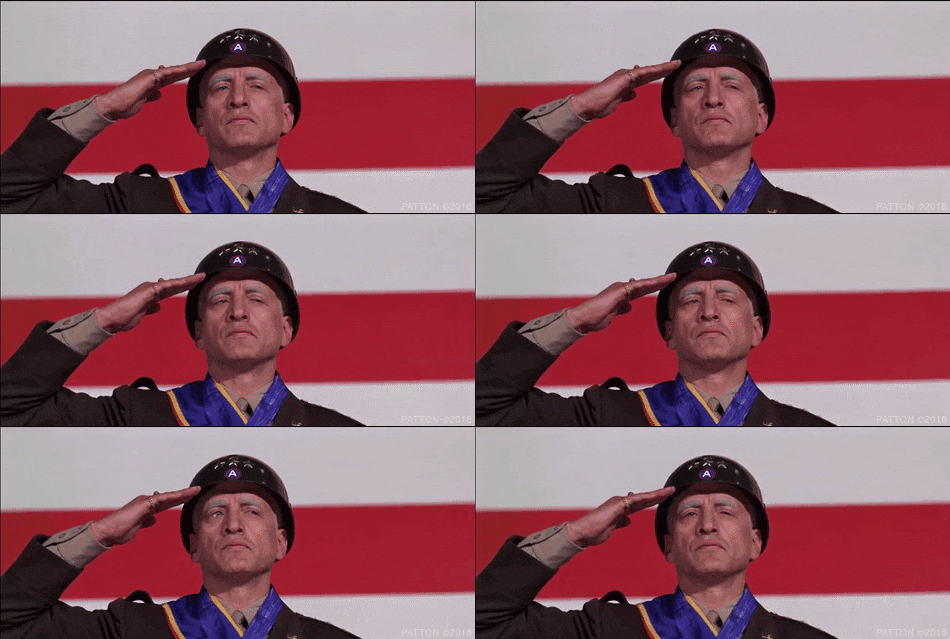
I. Unguarded Niche: (Or The Superstar Effect)
Most of the time it’s not enough to be better - you need to be different. Let’s take the example of Michael Silverman, a student from Paradise Valley, Arizona who got into Stanford even though his G.P.A. put him in the bottom 10% of accepted students. His SAT scores fell similarly short. Perhaps more surprising, Michael avoided the crushing course load that diminishes the will of so many college hopefuls, instead taking only a single AP course. He kept his extracurricular schedule equally clean — joining no clubs or sports and dedicating his attention to no more than one outside project at any given time. Despite this heretical behavior, no exotic genealogy, and no rich parents, Michael was still accepted into Stanford. How is this possible? Let me turn your attention to an obscure 1981 economics paper published in the American Economics Review.
The economist Sherwin Rosen worked through the mathematics that explains why superstars reap so many more rewards than peers who are only slightly less talented. He called the phenomenon, “The Superstar Effect.” Though the details of Rosen's formulas are complex, the intuition is simple: Imagine a million music fans who each have $10 to spend on an album. They're trying to decide whether to buy an album by the Beatles or the Byrds. Rosen's theory predicts that the bulk of the consumers will purchase the Beatles album, thinking, roughly: "although both bands are great, the Beatles are the best, and if I can only get one album I might as well get the best one available." The result is that the vast majority of the $10 million goes to the Beatles, even though their talent advantage over the Byrds is small (yeah I like the Byrds, fight me). This same principle is found in endorsement deals for athletes to sales of opera tickets in Italy.
Heading back to college now, this principle was found to apply even in settings that have nothing to do with financial transactions. In a particularly compelling example, a researcher namedPaul Atwell, publishing in the journal Sociology of Education in 2001, studied the Superstar Effect for high school valedictorians. Atwell imagined two students both with 700s on their SAT tests. The first student was the valedictorian and the second student was ranked number five in the class. Rationally speaking, these two students are near identical — the difference in G.P.A. between the number one and number five rank is vanishingly small. But using statistics from Dartmouth College, Atwell showed that the valedictorian has a 75% of acceptance at this Ivy League institution while the near identical fifth-ranked student has only a 25% chance. So, how do we hack this psychological oversight?
Taking an even further step back, we likely agree that it's an interesting but obvious finding that being the best has a hidden advantage. If reaping this advantage, however, requires becoming class valedictorian or creating a revolutionary band— both staggeringly difficult feats — it doesn't seem all that applicable. This is where Michael reenters the picture.The details of his story reveal a crucial addendum that makes the power of the Superstar Effect available to most people. I call this addendum The Unguarded Niche Corollary because I have low intellectual esteem & need to use big words to validate my intelligence - and it's here I turn your attention next.
You can trigger the Superstar Effect without requiring a rare natural talent or years and years of grinding work. For example, consider the details of Michael's story. Starting as a freshman, he focused all of his extracurricular energies on a serial string of environmental sustainability projects. He started by submitting a model of a greenhouse to a competition. This led him to discover that a local energy company offered a grant program for local high school students. With the help of a retired engineer from his hometown, he retrofitted a golf cart to run on biofuels. Leveraging this success, he earned a grant which he used to install solar panels on his school's maintenance shed. This earned him press coverage, and the resulting Superstar Effect helped wow the Stanford admissions department into overlooking his below average scores. Notice that nothing about Michael's rise to stardom required a rare natural talent or overwhelming workload. His projects required, on average, less daily time investment than participating in a highschool sport. Yet, he was the best at what he did among all applicants to Stanford, and the resulting Superstar Effect earned him a disproportionate reward.
Being the best in a field makes you disproportionately impressive to the outside world. This effect holds even if the field is not crowded, competitive, or well-known. In other words, becoming valedictorian or a sustainability guru both generate the same Superstar Effect, but the former is much harder than the latter. Beyond that in the case of Michael is the need from Stanford and just about any media outlet for good stories; interesting students to talk about in promotional materials and alumni magazines. Michael is one of these interesting students who exhibit passion and an ability to take advantage of opportunities they come across.
For anyone looking to increase his rewards-to-effort ratio it’s important to hack this principle, not by becoming the best - but the only. This can be helped by sloganizing your conquest to transform it into an easy-to-describe and immediately interesting quest. For example, Chris Guillebeau, sloganized his goal of adventure travel writing by focusing on the catchy goal of visiting every country in the world. A similar example is of a web programmer mastering a new open source technology, she might sloganize her efforts by writing a definitive eBook on the subject. To say that she literally "wrote the book" on the technology gives the expertise extra power.
When conquering your uncontested niche, it can be tempting to divide your attention. Here is where diligence is key. The bonus reward you get for being the best far outweighs any small benefit that a shiny new side project can provide. On the large scale, therefore, maintaining a relentless focus on your conquest maximizes your total overall reward. We're wired to be disproportionately impressed with someone who is the best at what they do. This effect, however, is blind to the competitiveness of the pursuit. The writer who is traveling to every country in the world, for example, can earn as much attention as the Rhodes Scholar with a PhD in international relations. It’s better to create a category than to fight in one. Being first and then striving for perfection — instead of fighting to be best in a crowded space — is the fastest path to mindshare.
An easy way to avoid being pigeon-holed is to create a more appropriate label (i.e Filmmaker vs. Actor) or create a new one which offers the ultimate calling card: one you dominate as you define it. Produce a simple and understandable label for both media and people looking for an alternative to the current options. Create instead of imitate. From an SEO standpoint it’s more effective, and from an intellectual and explicative standpoint, it’s more accurate. The current collection of labels are often too broad to encapsulate an innovation you want to turn into a movement.
Seth Godin says in every field, extraordinary benefits go to those seen as being in the top five percent. One out of twenty. Sure, the biggest prizes go to the once-in-a-generation superstar but that’s largely out of reach. It turns out, though, that if you’re thoughtful and diligent, the top 5% is attainable typically within 3-6 months. The approach is to pick the right set to be part of. Not “top 5% of all surgeons,” but perhaps, “top 5% of thoracic surgeons in Minnesota.” Be specific. Find your niche and fill it. That’s challenging, because once you set out to be specific, you’re on the hook. The standards are more clear. No room to waffle. Which leads to the second half of the approach: The hard work. The work of leveling up and being honest about the choices that those you seek to serve actually have. If they knew what you know, would they choose you? What would it take for you to learn enough and practice enough and invest enough to truly be one of the top 5%?
The smaller the niche or target, the bigger the bullseye. For marketing, let’s look at the example of an erectile dysfunction pill. If you put an ad on national television it will get a lot of views but not a high ratio of purchases. How do we increase the ratio? What if we targeted cable channels for men, or men's health shows or men's health shows on sexual desire. That's a tighter focus which will bring greater rewards. Selling erectile dysfunction pills on Oprah won’t sell as well as that small show on men's health for that niche.
In the immortal words of Peter Theil “competition is for losers” . Instead of battling numerous competitors in a contested market, it is far better to seek fresh unguarded niches. So ask yourself, can you redefine or create a category, rather than compete in one?
2. Know thy audience: Must think marketing while writing
Below is a principle from Paul Graham that, although in reference to start-up companies, can easily be applied to filmmaking:
“Most startups fail because they don't make something people want, and the reason most don't is that they don't try hard enough. A surprising number of founders seem willing to assume that someone—they’re not sure exactly who—will want what they’re building. Do the founders want it? No, they’re not the target market. Who is? Teenagers. Or ‘business’ users. What business users? Gas stations? Movie studios? Defense contractors? Whenever I am considering an idea, I picture the seats rising from second base at Yankee Stadium. Can I sell that many tickets? Half that many? Twice that many? What if you can identify a perennial problem and solve it? If you can create something for an audience that renews itself each year (like college grads or people turning 50)? Then you’ll have something that can last and sell by word of mouth. Life is short, and we can read only so many books—by choosing one, I’m choosing explicitly to not read another. That weighs heavily on consumers.” - Paul Graham
The “marketing” is then finding people who most resemble the friends you wrote the movie for in the first place. Get specific enough so that this “audience” comprises no more than 2,000,000 people nationwide. Next, find the few curators for this niche audience and only talk about your movie content if you’d be willing to bet $1,000 on fit. Fit = they’d definitely watch a recommended scene or read a specific section of script in the subsequent 24 hours. Anything less is, in my opinion, just in-person spamming. Know thy audience.
A macro example of this is the Will Smith method, recently stolen by Dwayne Johnson to great success. Smith would do weekly meetings discussing the top ten box office results. “Listen, if we're going out to L.A., we probably should have a goal,'" Smith says. "I said, 'I want to be the biggest movie star in the world.'" Lassiter (his agent), took his friend seriously and found a list of the 10 top-grossing movies of all time. "We looked at them and said, O.K., what are the patterns?" Smith recalls. "We realized that 10 out of 10 had special effects. Nine out of 10 had special effects with creatures. Eight out of 10 had special effects with creatures and a love story." This ties into the tenant of knowing thy audience when writing.
For Indie movies, Netflix would find 3-similar film titles and promote the indie movie that was showing locally within 10-miles of individuals who liked 2 out of the 3 films most similar to it.
This also helps in marketing as your methods should be based on the target audience (i.e kids don’t read newspapers, teenage girls don’t read business magazines, adult males don’t buy romance novels, it doesn't make much sense to pitch life insurance on tik tok, so on and so forth). Go to where your audience is. Great example of this was Solar companies wasting money pitching to talk shows, but when they went to Star Trek conventions did crazy numbers. Know thy audience.
3. Overcoming Icky: Sales Strategies
There is this notion that some people have that artists must toil in obscurity and never search for an audience, but wait to be discovered. Fuck that. A creator’s job is not just to make something useful; it’s also to get it to people who can use it. If you aren’t willing to promote your idea why would anyone be willing to pay for it?
Some avoid sales & negotiations for the same reason that a fat guy avoids the gym: They don’t know what the hell to do. For negotiating, it often evokes similar feelings of discomfort resembling an impromptu dance of haggling. However, it doesn’t have to be this way. A dealmaker meticulously choreographs his sequence, plotting several moves ahead, maneuvering his opponent into a checkmate. Below are some of those maneuvers:
He who cares least wins (i.e have options): Maintain the upper hand by cultivating an air of nonchalance. Possessing alternatives strengthens your negotiating position.
Fear-set (identify worst-case scenario and neutralize it): Confront the fears associated with potential losses head-on. Render them toothless to diminish their impact on the negotiation.
Approach at deadline: Use time constraints to your advantage. As deadlines loom, leverage the pressure to secure favorable terms.
Have them start: Shift the burden of initiating the negotiation onto the other party. Frame it as an opportunity for them to set the stage, while positioning yourself as a willing collaborator. (“You’ve done this before, how about you put something on the table for us to discuss?”)
Flinch & Counteroffer: Express mild dissatisfaction with the initial offer (the "flinch") before swiftly presenting a counterproposal that aligns more closely with your objectives.
Call back and meet in the middle: If initial negotiations stall, suggest talking to your “boss”. Use this time to recalibrate your approach and find common ground, facilitating a mutually beneficial compromise.
In a sales context, below is the straight-line method in a heavily condensed version. This is the system that was used by the famed Wolf of Wall Street who would train a staff of high school drop-outs in the system, turning them into millionaires almost overnight. It goes as follows:
Intro: Give intro presentation where you appear enthusiastic, sharp, and an expert in your field
Questionnaire: Gather intelligence & build rapport by asking a series of targeted questions.
Ask for the sale: They will say no - prepare for this. The sale begins at no, you want them to say no.
Objections: Obliterate objections through airtight logical and emotional cases to get them to understand they should buy now
Ask for sale:
Loop: Loop back on other objections, make sure they love you, the product, and the company.
Ask for sale:
Loop: Loop back again, boxing them in through logic, emotions, lowering action threshold, and raising beliefs.
Ask for sale:
Close: Either part mutually or close sale. Ask for a referral if close, give them recommendation if not.
Another effective strategy revolves around the paradox of choice—a concept observed in everyday scenarios like gas stations. Presenting three options—Gold, Silver, and Bronze—typically results in a significant majority favoring Gold and Bronze, leaving Silver neglected. Applying this principle to our strategy, we'll offer choices between domestic and international markets, each tiered as Gold, Silver, and Bronze. To succeed, we must master the art of:
Crafting a concise and compelling benefit message tailored to our ideal 1,000 customers.
Securing and prominently showcasing testimonials and case studies to build trust and credibility.
Providing a straightforward trial option to large enterprises, albeit with a charge to ensure they value the service.
Delivering exceptional customer service to our most valuable customers, while avoiding being derailed by the demands of those with more time than budget.
Leverage your existing skills and view social media platforms like Twitter and Instagram as vital communication channels. Maintain perspective—there's no need to respond to every comment or criticism, just as in your personal life. Focus on what truly matters and allocate your resources wisely. By mastering these strategic maneuvers, you can navigate negotiations with finesse, guiding them toward the desired outcome.
PR at best gives you credibility and at worse gives you name recognition. You can often get cheaper deals on your ads or trailers by targeting local slots of large publications. Instead of Time Magazine, just do the El Paso version. Remember, rate cards are fictional starting points. Always shop regional, a 30-second ad can do as much as 60-seconds, and but last minute in non national targeted locations. Always look for circulation & page visit numbers for blogs, and on aggregate magazines are better than newspapers as they have a more focused readership.
4. 1,000 True Fans
Below is a dissemination of the article 1,000 true fans by Kevin Kelly. I’d recommend reading the entire article but for internal documentation purposes I’ll include an abridged version below.
Target: 1,000 superfans. First, you have to create enough each year that you can earn, on average, $100 profit from each true fan. That is easier to do in some arts and businesses than others, but it is a good creative challenge in every area because it is always easier and better to give your existing customers more, than it is to find new fans. This ties into the Seth Godin principle of permission marketing which basically means that you don’t carpet-bomb everyone with your ads; you actually ask your fans for permission to tell them about the things you are doing. The most obvious permission marketing tool is an email list. Works great if you only send out something like two emails a year or a weekly newsletter - but always make them highly relevant. He uses his FB fan pages in the same way; people “like” them in order to get info about him and things he’s doing, and he only posts when it’s highly relevant.
This is a pretty simple but powerful concept. Once a fanbase is established through permission marketing, you can use your fanbase to launch products ala Kevin Hart/Dane Cook who, at each and every show, would have an assistant put a business card on each seat at every table that said, “Kevin Hart needs to know who you are,” and asked for their e‑mail address. After the show, his team would collect the cards and enter the names into a spreadsheet organized by location. For four years he toured the country this way, building an enormous database of loyal fans and drawing more and more people to every subsequent show.As his name grew, Hart began to take television gigs that he thought would allow him to grow his platform. In 2011, he hosted the MTV Music Awards and snagged, by his count, more than 250,000 Twitter followers in one swoop. Across social media and e‑mail, Hart’s fan-by-fan ground game—in his words, “years of me building and building and building and reaching out to my fans on the personal level”—built up a platform of more than fifty million people, people he can launch each of his products too. Got this method directly from Dane Cook who built his following by responding to every DM on myspace and literally calling fans up out of the blue to talk. If someone asked if it’s really him, he’d call them.
Questionnaire:
What type of ____ do you ____?
Two main reasons you ____
Would you want ____?
Age/Gender?
What ___ do you read/watch? What's your favorite ___ page?
What of work do you do?
Where else do you go for ____?
Comments?
Kevin Kelly goes on to say the following: Second, you must have a direct relationship with your fans. That is, they must pay you directly. You get to keep all of their support, unlike the small percent of their fees you might get from a music label, publisher, studio, retailer, or other intermediate. If you keep the full $100 of each true fan, then you need only 1,000 of them to earn $100,000 per year. That’s a living for most folks. The actual number has to be adjusted for each person. If you are able to only earn $50 per year per true fan, then you need 2,000. (Likewise if you can sell $200 per year, you need only 500 true fans. Or you may need only $75K per year to live on, so you adjust downward. Or if you are a duet, or have a partner, then you need to multiply by 2 to get 2,000 fans. For a team, you need to multiply further. But the good news is that the increase in the size of your true-fan base is geometric and linear in proportion to the size of the team; if you increase the team by 33% you only need to increase your fan base by 33%.
Another way to calculate the support of a true fan, is to aim to get one day’s wages per year from them. Can you excite or please them sufficient to earn one day’s labor? That’s a high bar, but not impossible for 1,000 people worldwide And of course, not every fan will be super. While the support of a thousand true fans may be sufficient for a living, for every single true fan, you might have two or three regular fans. Think of concentric circles with true fans at the center and a wider circle of regular fans around them. These regular fans may buy your creations occasionally, or may have bought only once. But their ordinary purchases expand your total income. Perhaps they bring in an additional 50%. Still, you want to focus on the super fans because the enthusiasm of true fans can increase the patronage of regular fans. True fans not only are the direct source of your income, but also your chief marketing force for the ordinary fans.
This new technology permits creators to maintain relationships, so that the customer can become a fan, and so that the creator keeps the total amount of payment, which reduces the number of fans needed. This new ability for the creator to retain the full price is revolutionary, that the most obscure node is only one click away from the most popular node. In other words the most obscure under-selling book, song, or idea, is only one click away from the best selling book, song or idea. Early in the rise of the web the large aggregators of content and products, such as eBay, Amazon, Netflix, etc, noticed that the total sales of *all* the lowest selling obscure items would equal or in some cases exceed the sales of the few best selling items. Companies like Google, Bing, Baidu found it in their interests to reward searchers with the obscure because they could sell ads in the long tail as well.
1,000 true fans is an alternative path to success other than stardom. Instead of trying to reach the narrow and unlikely peaks of platinum bestseller hits, blockbusters, and celebrity status, you can aim for direct connection with a thousand true fans. On your way, no matter how many fans you actually succeed in gaining, you’ll be surrounded not by faddish infatuation, but by genuine and true appreciation. It’s a much saner destiny to hope for. And you are much more likely to actually arrive there.
A creator, such as an artist, musician, photographer, craftsperson, performer, animator, designer, videomaker, or author—in other words, anyone producing works of art—needs to acquire only 1,000 True Fans to make a living. It’s a small empire and one that must be kept up, but an empire nonetheless. Like Latvia or Romania.
Does 1,000 true fans sound too difficult? Fine - start with 10. Find ten people. Ten people who trust you/respect you/need you/listen to you…Those ten people need what you have to sell, or want it. And if they love it, you win. If they love it, they’ll each find you ten more people (or a hundred or a thousand or, perhaps, just three). Repeat. If they don’t love it, you need a new product. Start over. Your idea spreads. Your business grows. Not as fast as you want, but faster than you could ever imagine. This approach changes the posture and timing of everything you do. You can no longer market to the anonymous masses. They’re not anonymous and they’re not masses. You can only market to people who are willing participants. Like this group of ten. The timing means that the idea of a ‘launch’ and press releases and the big unveiling is nuts. Instead, plan on the gradual build that turns into a tidal wave. Organize it and spend money appropriately. The fact is, the curve of money spent (big hump, then it tails off) is precisely backwards to what you actually need.
It also pays to keep clients instead of hunt for new ones. More than half of marketing should be devoted to current clients. Don’t make the mistake of always targeting new. It’s not a new client, it’s a new relationship. 70% of business is lost due to after sale apathy. It costs 6x more to sell to a new person. So send that fucking follow-up email! Give them a chance to upgrade like car dealerships do. Increase the size of transaction, frequency and referrals. When you encounter a superfan, either through email or in-person , ask them if they’d be willing to be contacted by the press at some point and have a testimonial on record.
5. Super-Connector: The Jesus Method of Service (Wedding Crashers)(Rondo)(socialite)
Never underestimate anyone—every interaction holds the potential to shape your journey. Treat everyone with the reverence you'd afford someone who could thrust you onto the front page of The New York Times—because one day, they just might. Adopt a long-term mindset—relationships aren't about immediate gain, but rather about cultivating connections that can mutually benefit both parties down the line. Approach each encounter as an opportunity to extend a helping hand.
Consider this scenario: a reporter declines to cover your story. Rather than dwelling on the rejection, seize the chance to be of service. What's occupying her mind? Perhaps there's an untapped trend in a particular industry, and she's on the hunt for a founder with a unique angle. By connecting the dots and facilitating an introduction, you're not only assisting her but also aiding another individual—a win-win scenario that amplifies good karma
As time progresses, you have the opportunity to establish yourself as a pivotal connector within your industry. Connectors serve as a journalist's secret weapon, providing leads on untapped ideas or facilitating crucial introductions for insightful interviews. This position of influence ensures you remain at the forefront of their minds—a priceless asset in a world inundated with content. With professionals bombarded by pitches every minute, it's imperative to make yourself known. Embrace the role of the helper—any assistance rendered to enhance someone else's job performance earns you valuable startup karma. In a landscape where time is a precious commodity, your willingness to aid others sets you apart, fostering enduring relationships and solidifying your reputation as an indispensable ally.
When it's time to present your pitch, remember: it's not about pitching—it's about establishing personal connections. Prioritize individuals with whom you already share rapport, aiming for a genuine connection. If you must cold-email, keep it concise—aim for fewer than five sentences. Precision with impact is a potent writing skill.
The key to securing coverage lies in not overtly pitching your product. Journalists are human—they're not solely there to showcase your big idea. To capture their attention and goodwill, offer value. Pitch by not pitching—be genuinely helpful. Share links to breaking yet underreported stories, or facilitate introductions to fellow founders in their sphere of interest. Demonstrate your understanding of their preferences—inform them of relevant sales or events. When the opportune moment arises for a formal pitch, execute it with finesse. Until then, prioritize building relationships through meaningful engagement.This Bodes Question: How to become a super-connector? You can use cold emails or swag bombs but the least crowded channel will always be face-to-face.
In-person interactions remain the least crowded and offer the highest rewards, but they require skills that many lack. Once again, understanding your audience is paramount, and standing out often yields greater results than striving to be better. Visionaries like Tucker Max and Tim Ferriss allocated their entire marketing budget ($10k) to attend target-rich environment festivals, where they engaged with journalists and industry professionals at after-parties over casual drinks.
Their approach was simple yet effective: join a group and casually inquire, "Are y'all from xyz festival? Mind if I join in?" Then, engage in genuine conversation for a few minutes before offering to fetch drinks. Return, seamlessly integrate back into the conversation, and wait for curiosity to spark. Avoid the urge to pitch—instead, share your story naturally. If there's mutual interest, suggest exchanging cards and follow up with an email, maintaining the cool demeanor that initially drew them in. Remember, it's about fostering genuine connections and leaving a lasting impression as a cool, approachable individual. Another way is to approach the moderator of Q&A segments at festivals about topics on the panel until they ask what you're at the festival for. Again, do a quick spiel and say you're “trying to figure out (insert problem) Do they know anyone you should meet or would be interested in talking?” Now you have an in to your next person.
If possible, get guys to go to lunch the following day. Build relationships with people who can help you, and vice versa: Basically what people like Tucker Max, Ryan Holiday, and Tim Ferriss did was go to every conference and meet-up they could in the year or so before there books came out, made it a point to meet and befriend everyone who had an online audience that they thought might like their book–diverse groups, ranging from people like Robert Scoble to Robert Greene–gave them all copies of there book, established relationships with them, and learned everything they could from them. Then when their book came out, they had all their knowledge at their disposal, and had hundreds of very influential friends who were willing to talk about it to their specific audiences, both because they thought their audience would like it, and because they liked them as people. The brilliance of this strategy was that they met these people FACE-TO-FACE and created real human bonds with them. It was something no one was, or is, doing at the time, and they did it very well
This is why learning to elevator pitch — how to deliver your message in 60 seconds or less — is one of the most important skills to develop if you ever plan on interacting with real players. For meeting VIPs in crowded settings, the goal should be to do 3 things in an introduction of no more than 60 seconds:
Establish credibility. Cite 1-2 examples of social proof like media or association with reputable companies/organizations. Do not speak quickly during an elevator pitch. Slow and calm.
Make it clear you are not looking for money (unless you are) but have something of interest to discuss after much research, and then ask how you can follow up in a less hectic environment. Give them your card with below #3 handwritten on it.
Mention something very, very hard to forget about you that separates you from the rest. It doesn’t need to have anything to do with your reason for wanting to meet them. For Tim Ferriss, tango is his default. He’ll close with something like: “Just so you remember, as I know you’ll meet a million people today, I’m the world record holder in the tango. Happy to give you and Astrid a lesson sometime if the stars align.” Referring to this odd fact will be important when you follow up. Do not follow up within the next 3 days, as everyone else will. Give at least one week and then cite the reason in the previous sentence as your reason for waiting. Take notes on your conversations so follow up has some merit. Attempt for lunch the following day but don’t expect it.
So if you have lead time go to festivals, meet in person, hang out, and don't pitch. Below are some good questions to come preloaded with:
What do you do?
Where are you from? Say it as a statement or guess. It’s more fun and this isn’t a fucking interview. “You’re not from here are you? I can tell, lemme guess.”
How did you decide on your project? What ideas did you consider but reject, and why?
What were your biggest mistakes, or biggest wastes of time/money?
Key production, launch, and marketing lessons learned?
If you were to do it all over again, what would you do differently
What’s next?
6: Flexibility
As Eisnhower said “Plans are worthless, planning is indispensable”. People who demand concrete plans don’t understand that life is not a static process and that any written plan would have to be amended as circumstances swiftly change - making the written plan time consuming and ultimately useless. The big giants are stuck in release dates years in advance and rush out crappy work. We maintain maneuverability throughout. This also allows us to attack our enemies on multiple fronts which will spread their resources thin. Big corporations also can’t engage with fans on a personal level, we can.
7. Virtual Assistant & Team
Do not run a campaign (or your life) without a VA. They will save you countless hours of work so long as you remove any decision making bottlenecks (i.e I’ll let you figure it out, go for it, try it, etc.). To properly incentivize assistants, create teams that compete against each other with a bonus for high performers. A classic way to burn through cash though is by hiring a lot of people. This bites you twice: in addition to increasing your costs, it slows you down—so money that's getting consumed faster has to last longer. Most hackers understand why that happens; Fred Brooks explained it in The Mythical Man-Month. So for hiring assistants, as well as the rest of the team (a) don't do it if you can avoid it, (b) pay people with equity rather than salary, not just to save money, but because you want the kind of people who are committed enough to prefer that, and (c) outside of assistant, only hire people who are either going to make the film (crew) or go out and get viewers (sell), because those are the only things you need at first. What if I hire bad people? That’s a double edged sword as most people don’t know what to look for in good workers and most good workers don’t want to work for someone else's vision. This is a skill to be honed so be slow to hire, but fast to fire.
TLDR: Hire a virtual assistant to handle email follow ups, festival outreach, marketing posts, schedule management, booking speaking engagements, doing research, and more
8. Antithesis: Adversity to Advantage
Every challenge holds within it a hidden opportunity. This concept, often referred to as the inverse relationship principle, originates from the startup ecosystem. Consider this: companies with less funding frequently outperform their deep-pocketed counterparts (think Nike & Alibaba). Investors find themselves perplexed. Shouldn't more capital equate to greater success? Surprisingly, it's quite the opposite. Scarcity breeds ingenuity. Limited resources force every expenditure to be meticulously scrutinized, spurring founders to innovate rather than emulate their financially superior rivals. It fosters a mindset of first principles thinking. Conversely, an excess of funds breeds complacency, fostering a false sense of security. The saying goes that when start-ups get large rounds of funding they move to the suburbs and have kids. In other words, they lose their edge.
Similar dynamics apply to other constraints faced by underdog companies. Have no press? Fantastic! You're a blank canvas, unencumbered by past missteps or expectations, poised to chart your own course. Lack connections? Even better! You have the freedom to set trends rather than follow them, don’t owe anyone favors, and have ample time to hone your skills. Rushing in prematurely, without adequate preparation, only leads to obscurity. But don’t believe knowledge is the end all be all. Let us heed the wisdom of Orson Welles who said "The greatest thing I can bring to film - is ignorance”
Ask yourself - have individuals of lesser intellect or facing graver circumstances than myself conquered the odds? Almost invariably, yes. Playing it safe doesn't propel progress; it merely stagnates it. It's the daring souls who defy convention that rewrite the script of possibility. History reverberates with the echoes of the audacious, those who dared to dream the impossible into existence. Life hinges on the shoulders of the unyielding, the ones deemed unreasonable by societal standards. So, embrace the irrational, for therein lies the path to greatness.
BA: No money is good. It forces us to be creative, focus on principles, and scrutinize every expense. Larger rivals have a false sense of security and built in complacency. The employees are not rewarded for breaking to status-quo, but in fitting into it. No press is good as we are a fresh new story in a world eager for them. No network? Great, we are beholden to nobody and have no favors owed. No experience? Orson Welles said the greatest thing he could bring to film was ignorance. We are ready.
9. Big & Historic Attracts Investors
People like to be a part of history and it’s easier, or of similar work, as lesser goals which go uncontested as no one bothers to show up as they overestimate the competition. Author Tim Ferriss found this out when he offered a round-trip ticket anywhere in the world to his Graduate class at Princeton. In order to know what the challenge was they were to stay after class if interested. As he told the roughly 60 students who stayed after, the trip would be rewarded to whomever could get in contact (phone, email, letter, carrier pigeon, whatever) with the most impressive person (politicians, celebrities, athletes, etc.). The deadline was next week and the students who remained signed up for the challenge. With a class of roughly 60 of the smartest minds that academia can produce one could expect some impressive results - right? Wrong. Of the 60 students, NOT A SINGLE ONE even submitted! They all complained of either no connections, not enough time, or a litany of other excuses.
Depressed, Tim offered the same challenge to an undergraduate class later that year, but with one caveat - he informed them of the prior class's failure to submit even one submission to the challenge. By his own rules, if someone would have sent him an email conversation with their dog he would have been forced to award the trip to them. This second class, in the same amount of time, produced correspondences ranging from Jay-Z to President George H.W Bush. Now, was the second class smarter or better connected? No, arguably they were lesser in both ways but they had one key advantage - a trigger finger.
DON’T OVERESTIMATE THE COMPETITION! Especially for big goals which most people are too busy, dumb, lazy, fearful, or weak willed to even contemplate let alone attempt. Understand the urgency of the situation. Half-measures simply won’t do. This leads back to the original point of people wanting to work on large projects. No one wants to help you raise $1,000 dollars for your hamsters bar mitzvah, but you can raise millions of dollars fairly quickly for a mission to put a tree on Mars, which is what Elon Musk did to help fund Space-X in the early days - even before ever having a prototype. Big goals inspire and you aren’t serving the world by playing small anyways. People like to be a part of history, so to gather investors - make history. Doesn’t have to be hard (see unguarded niche section) but it’s important to have a large inspiring goal to lean on when the inevitable set back occurs.
Let’s use a flat tire example. Say you are taking an expenses paid trip to Paris. You wake up and go out to your car and you see it has a flat tire. Let’s use this same scenario, but instead of Paris you are going to your nephews soccer tournament which you promised your sister you’d attend. In both scenarios you have a flat tire, but in one instance that might be enough to just stay home for the day and for the other it is but a minor inconvenience on an otherwise glorious day. Perspective drives performance so thinking big isn’t some buzz-feed tactic, it’s mandatory to draw in others, as well as yourself. This is also a key mistake that front-runners make, they don’t take risks in order to preserve their lead and thus slowly fall into decay. If you can get the lead dog to punch down, that validates your position and raises you up.
It’s important to focus on big-picture and not get married in detail. Details will change but the vision will remain. Reagan was a big picture thinker in politics, as was FDR & Obama. They never gave details, just a vision. Similarly Woodrow Wilson was the originator of this in modern terms and we still follow he foreign policy 100 years later. However, this does lead to a quick side tangent on Investor Management which is one of the major reasons companies fail. (You may skip over this section if Investor Management is of no interest to you)
Notes on Investor Relations:
Famed Investor Paul Graham advises startups to set outside standards low, initially: “spend practically nothing, and make your initial goal simply to build a solid prototype (read short film). This gives you maximum flexibility. Some key issues are going to be spending too much and raising too much money: When you raise a lot of money, your company moves to the suburbs and has kids. Perhaps more dangerously, once you take a lot of money it gets harder to change direction. He advises founders who go on to seek VC money to take the first reasonable deal they get. If you get an offer from a reputable firm at a reasonable valuation with no unusually onerous terms, just take it and get on with building the company. Who cares if you could get a 30% better deal elsewhere? Economically, startups are an all-or-nothing game. Bargain-hunting among investors is a waste of time.”
As a founder, you have to manage your investors. You shouldn't ignore them, because they may have useful insights. But neither should you let them run the company. That's supposed to be your job. If investors had sufficient vision to run the companies they fund, why didn't they start them? Pissing off investors by ignoring them is probably less dangerous than caving in to them. Err on the ignoring side. A lot of energy gets drained away in disputes with investors instead of going into the film. But this is less costly than giving in, which would probably destroy the company. If the founders know what they're doing, it's better to have half their attention focused on the product than the full attention of investors who don't. When you raise VC-scale money, the investors get a great deal of control. If they have a board majority, they're literally your bosses. In the more common case, where founders and investors are equally represented and the deciding vote is cast by neutral outside directors, all the investors have to do is convince the outside directors and they control the company. If things go well, this shouldn't matter. So long as you seem to be advancing rapidly, most investors will leave you alone. But things don't always go smoothly in startups. Investors have made trouble even for the most successful companies. One of the most famous examples is Apple, whose board fired Steve Jobs.
So, how do you get investors? Create a pitch deck & use an anchor tenant. An anchor tenant is a person who draws in others. You’ll usually have to buy them. This can be done as simply as saying to them or their representation “I’d like to donate $10k in your name to XYZ”. It’s a win-win. They get to donate to a good cause and you get a prestige name attached to your project. View super-connector & swag bomb sections for further examples.
The failed startups you hear most about are the spectacular flameouts. Those are actually the elite of failures. The most common type is not the one that makes spectacular mistakes, but the one that doesn't do much of anything — the one we never even hear about, because it was some project a couple guys started on the side while working on their day jobs, but which never got anywhere and was gradually abandoned. Be willing to pivot and launch quickly. One reason to launch quickly is that it forces you to actually finish some quantum of work. Nothing is truly finished till it's released; you can see that from the rush of work that's always involved in releasing anything, no matter how finished you thought it was. The other reason you need to launch is that it's only by bouncing your idea off users that you fully understand it.
Several distinct problems manifest themselves as delays in launching: working too slowly; not truly understanding the problem; fear of having to deal with users; fear of being judged; working on too many different things; excessive perfectionism. Fortunately you can combat all of them by the simple expedient of forcing yourself to launch something fairly quickly. Launching too slowly has probably killed a hundred times more startups than launching too fast, but it is possible to launch too fast. The danger here is that you ruin your reputation. You launch something, the early adopters try it out, and if it's no good they may never come back. So ask, what's the minimum you need to launch?
Another key issue is running out of money: Startup funding is measured in time. Every startup that isn't profitable (meaning nearly all of them, initially) has a certain amount of time left before the money runs out and they have to stop. This is sometimes referred to as runway, as in "How much runway do you have left?" It's a good metaphor because it reminds you that when the money runs out you're going to be airborne or dead. Too little money means not enough to get airborne. What airborne means depends on the situation. Usually you have to advance to a visibly higher level: if all you have is an idea, a working prototype; if you have a prototype, launching; if you're launched, significant growth. It depends on investors, because until you're profitable that's who you have to convince. So, we need a prototype (i.e short film)
10. Convenience is King
There’s another cost that creators tend to miss: How much does it cost for people to find your work? To read the reviews or read an article about it? How much time does it cost to download, wait for it to arrive, or set up? How long does it take to actually watch the move? These costs—discovery and transaction costs—exist even when your work is free! Think of the free concerts you haven’t attended, the samples you didn’t bother to walk over and try, the products you didn’t buy even though they were 100 percent risk-free, love it or get your money back, no money down. When you think about it this way, it’s really amazing that people buy or try anything at all. So, we need to make the entire process as easy & seamless as possible. The more you reduce the friction of purchasing, the more people will likely try your product (i.e Amazon one click ordering). This means price, distribution, and other variables are essential marketing decisions to be serviced. Ease of access is also ease of payment (i.e accept all payment types). Take the famed grocery store experiment where they wrapped $20 bills on the bottles of pop at the bottom of the shelf. The result? They still undersold the middle of the rack sodas as simply put - no one looks down there. Eye level is buy level. Run your business in a way that’s convenient for customers. Confidence, quality, and convenience are the core of any business.
TLDR: Eye level is buy level so it is paramount our films appear on the home or main screen of streamers.
11. #1 Metric: Profits
THE cornerstone metric? Profit. Keep your eyes fixed squarely on the bottom line. Sales are easy, anybody can do those. The skilled turn a profit. Deals will incessantly flutter around you, demanding attention. It's imperative to discern your core metric amidst the whirlwind. Let's delve into a literary example: consider a book priced at $20, where the author pockets a mere $2-3. Now, ponder this scenario: with a $50,000 advance, a $20 cover price, and a 10% royalty, they’re now tasked with moving 25,000 copies to surpass the advance ("earning out"). Achieving profitability hinges on efficiency and savvy, not mere temporal investment. The startup's financial compass should unfailingly point towards a singular aim: maximizing profit swiftly and effortlessly. It's not about amassing more customers, revenue, office spaces, or staff; it's about optimizing profitability. Thus, in deal-making, let profit be your North Star. Profits, not brand awareness, visibility, likes, followers, or other fools metrics. Results: Money. Don’t spend (waste) a lot of money on image, brand, and presence. Try putting views or likes on a bank deposit slip. It’s important to note that in 2017 Facebook caught misreporting viewership on ads so always just use profit as key focus.
TLDR: Don’t focus on reviews, customers, sales, revenue, etc. - focus on profit
12. Perception Drives Performance
Success is often a matter of perception. We must be perceived as professional and high status in all BA Production endeavors. Success hinges greatly on perception. Let's keep it simple: would you invest in a lackluster movie? With a staggering 17,000 movies hitting the screens annually, professionalism becomes the minimum required for entry. Professionalism isn't just a suggestion; it's the baseline. Every aspect, from cover art to trailers, scenes to posters, must exude an aura of prestige, encapsulating the essence of our narrative feature. Crafting a compelling movie description is paramount, offering viewers a glimpse into what awaits. Quality is so important that it is the ticket to admission to even be in the game. A high quality success frame is key throughout business and personal relationships. Rock Stars have groupies because they’re stars, not because they’re good looking.
ROGER STONE RULES:
This also goes into fashion. Life is a performance so always be in costume when representing BA Productions. This tedious work is necessary as the face of the brand. Is this vital for our assistant editor? Not necessarily, but for the CEO & CFO it is mandatory. Different roles require different responsibilities. Key to great dressing is to think carefully about it but make it look effortless and natural. Think carefully through what you’ll wear on TV. Dress like a preppy even if you aren’t one. Dress british. Savile row tailoring comes from the military tradition of full chest and tapered waist which fits business meeting & legal conferences. Italian tailoring is softer & slouchier, ideal for nights out. Know your shit. In meetings where you are well dressed, use a cigar. It gives you time to think. It also helps in the “he who speaks first loses'' notion. Only when you feel great can you crush those who oppose you on the battlefield. White shirt + Tan face = Confidence. JFK would tan for 30 minutes before debates. You think you're above JFK? Looking good inspires confidence and people buy you before they buy the product.
Internally dress yourself the same way. Understand you are the man, right now. Act like it. If that means doing drugs & drinking all night - then do it. If it means waking up at 4a.m to do a marketing meeting. Do it. You must show graceful, easy carelessness throughout. Never reveal calculation or effort. Nonchalance is the goal. Think Big. Be Big. That was the Trump slogan from the 80’s. Sinatra said “The big lesson in life, baby, is never be scared of anyone or anything”.
13. Inverse Monetary Theory
You don’t have to make your money back the same way you lost it. It’s a common principle in the investing world to avoid dumping your money in a dying industry or brand. This thinking helps for diversification of assets and limiting downside - what I’m proposing is that the inverse is also true. You don’t have to earn all your money from the way you make it. Let me explain.
Say you publish a book and now you are in the public light going around promoting your work. Most people will focus on making as much money as possible on the sales of that book, but what if you did the opposite? What if you sold the book for a discount to increase the amount purchased. For the sake of example, let’s say you drop the price from $10 to $5. What would this do? For the book, although profits would go down, the total sum of people who read it would go up and your name recognition would increase. With increased recognition, you begin to be invited to events to be a guest speaker. You are already well tuned to speak on the topics of your book and are prepared having gone through an entire book tour so you accept the offers. Person A who sold his book at $10 bucks may have sold 1,000 copies netting him a nice $10,000 (not to mention fees he’d have to pay to managers & publishers). We’ll say person B sold 40% less books which netted him $6000 bucks. Here, Person A is done and onto other pastures to go through the whole brutal process again. Person B is just getting started.
Now at the conference, Person B will be paid a speaking fee and sales of his book will invariably go up as well. Say he gets $500 for speaking and sells 100 books. Now he is at $7000 net. From here he gets signed to do a few more speaking engagements at a price of $500 for each. He thinks to himself, since he’ll be at these events anyways, he should make some shirts for his fans. At the end of these other speaking arrangements he hones his craft and gets 10% better each time, but now he has additional sources of revenue - speaking & merchandising on top of book sales. He makes $1000 at each subsequent event. In total, he now has $11,000 dollars. He also has a growing fan base by collaborating at different events, a merchandising funnel, the emails of those who purchased a shirt from him for permission marketing, and a larger fan-base than person A does. Person B is just getting started. He has multiple ways of making money, equally diversified so no one can tank him. It also allows him to have more control over his next project. He can even branch into podcasting, films, whatever he pleases as his money isn’t tied to one industry. He has leverage, room to grow & expand. Person B is free in all the ways Person A isn’t. Person B is in the driver seat, Person A is in the backseat.
14: Business Outlook:
Why
Let’s start with a story. One day a man was walking down a street and came across three guys making bricks. He asked the first guy “What are you doing?”
The first guy responded “Making bricks”
He asked the second guy what he was doing, who responded “Making bricks for a wall”
And he asked the 3rd guy, who said “I’m making bricks to build the wall of a glorious cathedral that will be used for the worship of god”
Of those 3 guys, who has the greater alignment of purpose? Yes, all of them are making bricks but the third guy understands why he is making bricks and the significance of it.
Why give purpose and alignment to the team. People don’t buy what you do, they buy why you do it. This also allows for the company to diversify without being limited to typical mission statements about targets, goals, and objectives. Starting with Why gives flexibility key to startups. This is also the key in hiring. Hire those who believe in what you believe, not just hire people who need a job. Those who just need a job will only work for the money, not in what you believe.
How (3-Year Vision)
3-years is the magic number. It gives you time to accomplish something big, which may require trial and error, and it gives you time to go down rabbit holes even if they don’t work out. The reality is that 10-years away is too foggy to visualize which gives a built in excuse to ignore it becoming at best a day dream and 1-month is too short to make any seismic changes or see the results of your work. Plus, new technology will come into play so it’s imperative we have time for innovation. Think about the difference from 2006-2016. Or from 2016 until now. 3-years also gives marketing time to do its job. Like a pool slowly filling with water.
3-years may seem far away but by backwards engineering it actually allows for the perfect amount of time for the realization of a project to come into fruition if the focus is on quarterly goals, year 2 objectives, and the overarching 3-year vision. Don’t get bogged down in minutiae, focus on the outcome, not the action. Actions may change, but the outcome will stay the same.
It’s important to have a clear vision as people can’t read your mind. Imagine you want to build a house and you tell the contractor you want 6,000 square feet with a deck in the back. How could anyone build a house from that description? It’s so vague it’s useless. A good vision allows for others to take control of the wheel for a bit in times of hardship. Say a family is on a road trip from New York to LA. They can take turns driving because everyone knows where they are heading. Same for business.
This also promotes stability as well as fosters a relationship with customers who feel excited and secure in purchasing based on reassurance that we thought through the products on a long term horizon with plans for improvement and are not a fly by night operation. Customers make decisions based on what company is going to look like in the future. It’s our job to share that information with them. Same with other businesses. Simply having a 3-year plan can increase the market capitalization of a 4-million dollar company to a 10-million dollar company just by having a clear future target, timeline, and experience which will help in the acquiring of a bank loan if needed or with vendors who may give better pricing terms as they start to see us as a larger company based on those valuations.
Furthermore, it helps the media understand more accurately what we do which will inspire the people bored of the same old stories. They can come along for the journey. Media is a necessary watchdog of society filtering out truth from fiction (for the most part) so it’s important they buy into us (News, magazines, newspaper, etc.). The more you convince the media, the more you convince the public who see the collaboration as a form of social proof and validation of your abilities. The media, eager to share the next big thing, will create a self fulfilling prophecy for your vision. It also allows us to control the narrative as in the absence of facts, people make up their own. Once the media disseminates our vision, marketing can leverage that by posting on X or FB links to our interviews with local news stations or articles. On a smaller scale it allows our team to attack projects on our timeline, not burden by the responsibility of an encroaching deadline and to take advantage of new opportunities in alignment with our goals.
What (Goal Setting)
Start with the desired results, then find others who have done it, create a blueprint, and work it. Adjust based on feedback which is garnered by weekly measurements. This means goals must be measurable, an often overlooked but critical point. How do you know if you got there if you don’t even know where the fuck there is? Cross off in green highlighter completed goals and highlight in yellow ones being worked on. Maintain a 3-6 month focus in alignment with 3-years vision. Always have the next 5-steps plotted out, as in chess.
Here's a simple rule: If you're not willing to bet $1000 on your success within 6 - 12 months, then either your goal is quixotic or you don't know enough about the field yet. In both cases, you're not ready for the project. A blind adherence to the flawed idea that getting started is the most important step is best left to cheesy motivational speakers — winners make plays with confidence.
15: Testing
Split test, judge one variable at a time. No opinion- not even yours. Results only. If you can’t clearly track money in the bank from something, stop doing it. Be committed to results. Failures arise from confusion, mixed agendas, and loss of focus on what produces results. Beware of the marketing world invaded by 20-30 year olds pushing clients to untold sums for online resources to social media they claim defies measurement from the old standards. They speak an invented language, new media gibberish, that confuses and intimidates their senior bosses. This mysticism is not new, it's as old as the ouija board. Old as wizards enriched by kings. It is a rerun. To avoid this, always test! Test the ad copy, the trailers, the poster, the name, everything! Fucking test everything!
16. Guerilla Marketing
“It’s not me, it’s you” - that would be a terribly great way to break up with someone but is also the key to guerilla marketing which is not me marketing, it’s you marketing. This means regular follow ups and getting people to visualize life after purchasing your product as being even better. Talk about how they will feel. People buy benefits, not features. Present a clear offer, an element of urgency, tell them exactly what to do, and plan the sale when you plan the ad. Your competition is not other movies, but any other person or thing advertising. So you must be creative, and creativity comes from knowledge. A writer just explains ordinary things in an extraordinary way.
Some lesser notes are that if you are giving ad reading to a professional (Podcaster) just give them outline of benefits and let them riff as it’s more natural. Print the most important sentence in a different color to stand out and restate the main offer. Sales copy needs an exciting benefit and call to action. Does someone want a 30-min sales presentation? NO. Do they want a free 30-min in home consultation? Sure. It’s the same damn thing. Remember to get referrals after sale as that moment immediately after purchase is the moment of highest satisfaction. Give them the sales copy and ask for a couple recommendations as that’s how you keep costs down. However, the only expensive marketing is one that doesn’t work. Cost has nothing to do with it. Although marketing means nothing if the work is of no quality.
17: Direct Marketing
Presentation of a very specific too-good to refuse offer. That's the main difference, not asking them to go to the page and like, asking them to go to the page to buy. Fire the wimps. Incorporate a direct offer each and every time you put out a message, of any kinds, by any means. Send thanksgiving, christmas, new year greeting cards to all customers, past & present, and include some form of offer in it (i.e gift with purchase, gift for referral, etc.) include it in a separate gift card to preserve some separation between the thank you and gift. Not a fan of discounting (buy one, get next free) as it lowers value. Gift with purchase better. Discounting trains them to only respond when a great deal is offered. It also limits it to only those available to purchase now, eliminating those who are able to purchase in the near future. It also allows them to comparison shop based on price. If they are interested, say you can send a dvd and brochure kit. (Just include email). Low threshold resistance. A key is low threshold offer which is sending free information to them to be accessed online. (Other examples are books, free reports, DVD’s). Mattress store doesn’t advertise itself, its mattresses or some sale of the century. It advertises its free guidebook. Karate school doesn’t advertise itself, its lessons, or a free lesson, it advertises a free report by its owners: The parent's guide to cyber bullying & bullying. “Will be sent by email. No cost. No obligation.” There will always be offer or offers. Offers are in the form of a hybrid where you offer a high barrier or medium barrier to entry offer like a $59 consultation of a free gift with purchase. So sometimes do all three but test.
Must be a reason to respond now. “Limited supply, countdown clock”. Can even use early-bird discounts and extended pay tied to a deadline if you can’t actually limit stock. Also use bonuses, entries into prize drawings, backstage-pass opportunities, preferred seating, closed-door limited table luncheons,. Door buster sales like starting at “7a.m.”. Bring movies out of the vault just until Halloween - then goes back in the vault and can’t be had” (Live timed auctions) Only 47 of whatever product will be sold at this price, in this color, with this bonus, etc. Most powerful is only having one available (Maybe run an auction?). Again, the notion of a high priced item to draw attention appears. Rent a local athlete for a bar and craft an afternoon of activities around their presence. Meet and greet photos, autographed footballs, jerseys, photos, etc. Watch the game with them is the private offer for 12 lucky people. A plane offer won’t move these lazy fucks out of there seats.
Give clear instructions. Confused customers do nothing. People rarely buy anything of consequence without being asked. “No postage stamp needed. We’ve paid the postage. Just drop in the mail”. Do not presume knowledge by the customer. Switch button form saying buy now to “click this button to buy now”. Include a “what to expect at your first appointment” email. Take great care in the ordering of a form for completeness and clarity. Everything ad wise must be tracked and measured for accountability. Permit no freeloader or slackers. This is because management by objective is the only type of management that works. Vagueness must be vanished. Do not shrug this off as too complicated. Think. Set up systems to capture the data you need and set aside time for analysis. If it’s difficult in the beginning the fog will clear, the difficulty will abate. Grow business without growing marketing. Key thing to track is offers & which media
No money to be spent on “Brand Building”. Not against it, but most startups don’t have the patient capital and luxury of time needed to brand build. Prove you have something to sell, prove you can craft a message that people will respond to. Healthy device, not just a kitchen appliance (used often)
Must follow up! Each point of contact costs something. When doing it for recommendation, send them shit with the label mentioning Betty’s recommendation. Follow up on newly acquired customers. They need to become frequent and habitual repeat purchasers or ascend to higher levels of membership. Or move from the first transaction to a committed relationship. That means they need to be quickly thanked, welcomed, and brought back, moved up, or otherwise committed. Indifference to customers leads to easy seduction elsewhere. There is a schedule where they should come back (Diner every morning, Car dealer every three years, clothing store once before each season). Here is pacing for follow up: Re-state, Resell, and extend same offer > Stern or humor 2nd notice tied to onrushing deadline. > Final notice > Change Offer. Can be done via email or elsewhere.
Yelling isn’t selling (curbside sign swingers). Sales and subtly rarely go hand in hand. In this environment the ordinary and normal are ignored. The cautious and calm message goes unnoticed. Most great sales copy is written backwards from the customer's interests, desire, frustrations, fears, thoughts, feelings, and experiences, journeying to a revealing solution or fulfillment tied to your business. Customer focused position. Don’t make your copy about the company, service, feature, comparative superiority, price, or guarantee. Each line (sentence) represents a complete idea. Don’t write professionally, but rather emotionally, with enthusiasm, and conversationally. Don’t be timid or bland in advertising (hit ball farther - than you ever had in your life) Remember to have copy direct them exactly to what to do. Don’t market yourself as timid, ordinary and uninteresting.
Ignore all advertising which isn’t mail order. Create swipe files of examples well done. What business you're in (deliverables) then realize you're actually in the marketing business…then realize you're actually in the money business. No opinion counts - not even yours. Only results. Split test to test positioning. Test one variable at a time. Only ballots counted are checks cashed. Will to win. Not try to not fail - win. Thick skinned toward criticism, tough minded about money invested, extremely disciplined in thought and action, and adherent to a winning game plan. Be alert to hazards and scams that lead you astray. Slogan “Bargain to those who can afford it, and out of price for most.”
Results triangle: Message, Market, Media. Most marketing product centric not customer centric. Who are you marketing too and where can they be found? Know your prime market, don’t care about offending the others. Information first marketing. Match bait to critter. Website not a fancy show off my kids, golf trophy, and here's my product and how great it is. Needs to be and act now page. Design an automated sequential follow-up. Buy one get one great offer.
18: Growth Hacking
Instead of bludgeoning the public with ads, use scalpel on the target audience - work backwards from the customer. Hit NYT for your scene. Clever stunt that puts you on the radar of taste makers who care. Use a demo video for a waitlist sign up and do a solid start that builds over time, not a huge opening weekend. When posting to niches, reference jokes from that community. Who are our early adopters and where can we find them? Start with no budget, if starting with budget and strategy isn’t one of growth on a dangerous treadmill you can’t get off. No TV ad or celeb endorsement, try to get that for free. Marketing is not worthless, just not worth the premium most people pay for it. Brand building in the first year or two is a total waste of time.
Have you made it easy for them to share it? Anything shared cannot be seen as a favor. Built for sharing, sample at scale, viewers stake in distribution. Keep them here! Retention is easier than acquisition. 10% Increase in retention leads to 30% increase in revenue.
To help with this, write FAQ for products before release to identify issues. Use CrazyEgg heat maps on your site or Survey Monkey or Wufoo. However, matrics are relative to what you’re trying to accomplish. Vanity metrics are easy metrics. Disney doesn’t measure itself by daily visitors that’d lead them astray. Use other networks to your advantage (Airbnb & PayPal did with Craigslist)
19: OPM
The breakdown of OPM stands for other-people's-money. A crass concept that is used mainly to locate strategic partnerships for win-win situations. This is very similar to fusion marketing. Some examples include trading 400 copies of a film in return for a full page ad, co-oping ad money from studios for movie releases, and inserting coupons for free dvd’s inside of Sony sold electronic devices. For film, you can even utilize dvd manufacturers & retailers to use their marketing muscle. As long as there is some incentive in it for them, OPM is an amazing opportunity for bartering.
20: PIVOT
You do not have to make your money the way you spent it. This is a subtly key point. For example, if you spent your money making a movie, you’d expect to make your money back on said movie sales, right? Wrong- in fact, the majority of your long term finances will come from authorship (blogs, books) which leads to (Speaking Engagements) which leads to increased sales in your merchandise which leads to further opportunities for jobs in adjacent niches (Commercials for example). All of these together will be more than the money you make on film. Take a page out of George Lucas book, he didn’t want control of movie - he wanted control of merchandising (Which actually helps movie gain notoriety).

CONCLUSION
Go forth & conqueror - the revolution has begun.